A piston cooling solenoid and an oil pump control solenoid can both be electrically controlled valves in the engine lubrication system, but they do not perform the same job. The most useful way to distinguish them is to identify the oil circuit each valve controls.
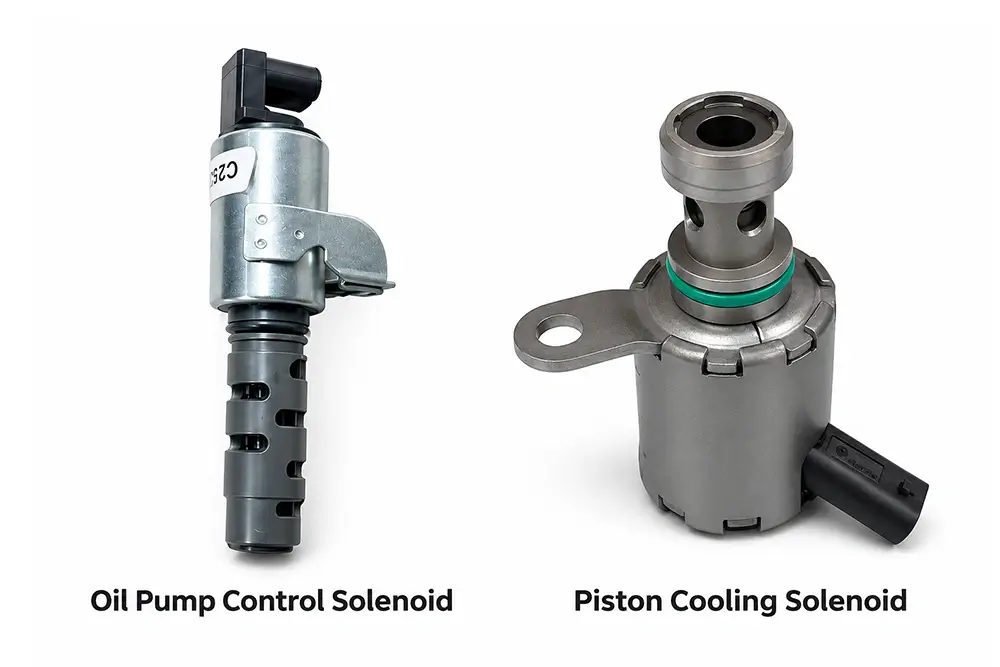
A piston cooling solenoid controls oil flow to the piston cooling circuit or piston oil jets. An oil pump control solenoid controls the hydraulic system used to change the operating state of a variable-displacement oil pump. Both may handle pressurised engine oil, and both may use similar electrical connectors, but they belong to different parts of the lubrication system.
For parts matching, this distinction matters more than appearance. A similar valve body or connector does not prove that two solenoids are interchangeable. Buyers should confirm the controlled circuit, OE reference, engine application, installed position and physical structure before approving a replacement.
Piston Cooling Solenoid vs Oil Pump Control Solenoid: Key Difference
The difference can be summarised by asking one question: what does the solenoid control?
The piston cooling solenoid manages oil flow to the piston-cooling branch. In engines that use controlled piston cooling, pressurised oil is routed through the valve towards piston oil jets or a related gallery. The jets then direct oil towards the piston cooling area according to the engine design.
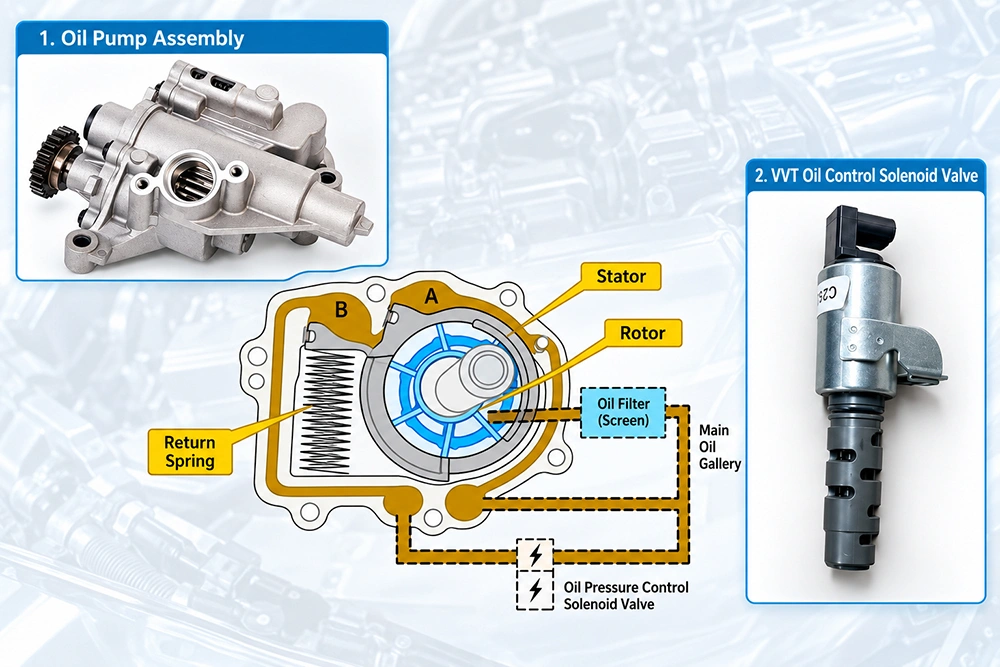
The oil pump control solenoid works further upstream. It is part of the control system for a variable-displacement oil pump. Instead of switching oil to the piston cooling branch, it changes the hydraulic condition that determines pump output or operating state.
| Comparison | Piston cooling solenoid | Oil pump control solenoid |
|---|---|---|
| Main purpose | Controls oil flow to the piston cooling circuit | Controls variable oil-pump operation |
| Controlled component | Piston oil jets / cooling gallery | Variable-displacement oil pump |
| Main system role | Piston cooling and lubrication management | Lubrication pressure and pump-output management |
| Directly pumps oil? | No | No |
| Main matching risk | Confused with VVT or another oil-control valve | Confused with piston cooling valve or the complete pump assembly |
The mechanical oil pump still provides the engine oil flow. The solenoids change how part of that oil system is controlled.
How They Work in the Engine Oil Circuit
A simplified lubrication path can be shown as:
Oil sump → oil pump → main oil gallery → bearings / valve train / turbocharger / piston cooling circuits
The piston cooling solenoid belongs to one downstream branch of this system. A simplified controlled piston-cooling path is:
Oil pump → main oil gallery → piston cooling solenoid → piston cooling jets → pistons
Its role is to open, close or regulate the oil passage feeding the piston cooling circuit where the engine architecture uses this type of control. It does not regulate the complete output of the engine oil pump.
Because catalogue terminology varies, this component may also appear as a piston oil cooling valve, piston cooling jet solenoid, piston cooling nozzle control valve or piston cooling oil control valve. These names describe a functional category, not proof that different OE references are interchangeable. For a broader component overview, see the piston oil cooling solenoid guide.
The oil pump control solenoid acts on a different part of the system. On a variable-displacement pump, the pump can alter its effective output according to the lubrication demand and control strategy of the engine. Depending on design, the solenoid can regulate hydraulic pressure acting on an adjusting ring, control chamber, cam ring, control piston or another pump-regulation mechanism.
A simplified control sequence is:
ECU command → oil pump control solenoid → hydraulic control passage → pump control mechanism → pump output changes
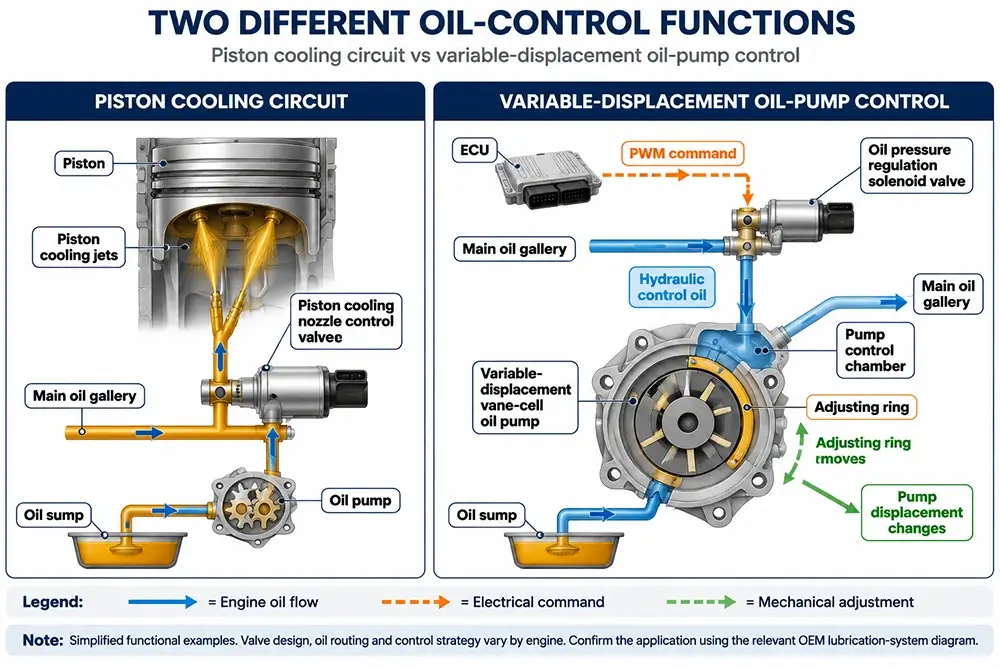
This means the piston cooling solenoid mainly controls where oil is routed, while the oil pump control solenoid helps control how the pump operates. For the wider pump architecture, see variable-displacement oil pump control.
The two valves can influence the same overall lubrication system, but they do not control oil pressure in the same way. A pump-control solenoid can affect the operating state of the variable pump itself. A piston cooling solenoid changes the state of a particular branch. Opening a piston-cooling circuit may alter system behaviour, but that does not make the piston-cooling valve an oil-pump control valve.
Location and Physical Identification
There is no universal installation location for either type of solenoid. Engine design determines where the valve is placed and how it interfaces with the oil galleries.
A piston cooling solenoid may be installed in the cylinder block, beside a piston-cooling gallery, within an oil-filter or lubrication module, or in another passage leading to the piston oil jets. An oil pump control solenoid may be mounted directly to the pump, installed in the engine block, positioned near the pump or integrated into a larger pump-control assembly.
Location is useful for narrowing the component type, but it is not enough for final identification. A buyer should compare the complete valve and the original installation position rather than relying on a general description such as “oil control valve” or “near the oil pump”.
| Identification point | What to compare | Why it matters |
|---|---|---|
| OE reference | Complete number from the original component or application-specific parts record | Establishes the initial part identity |
| Connector | Shape, angle and terminal count | Confirms electrical interface but not hydraulic function |
| Valve-body dimensions | Diameter, inserted length and body profile | Determines whether the component fits the receiving bore |
| Oil ports | Position, size and orientation | Determines which hydraulic passages are connected |
| O-ring / seal position | Groove location and sealing diameter | Separates oil circuits and prevents leakage |
| Valve tip | End profile and visible openings | Can reveal a different internal control design |
| Mounting flange | Bolt-hole position and installation angle | Confirms orientation and installation relationship |
| Installed position | Original location on engine or pump | Helps confirm which oil circuit the valve controls |
Connector similarity alone is not enough. Two valves can use the same connector while controlling completely different oil circuits.
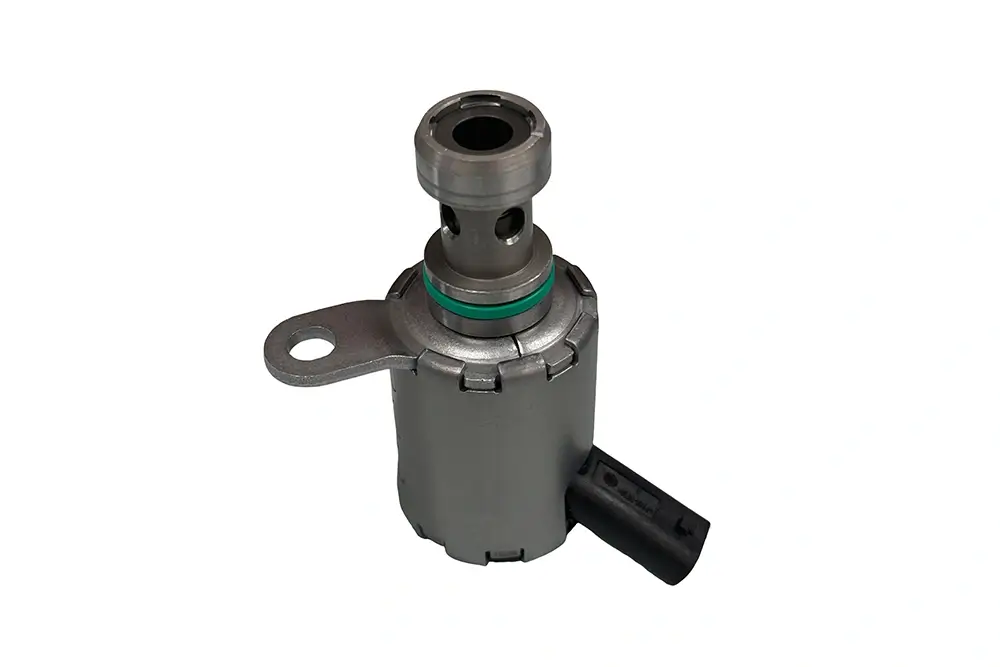
Wellgine’s LR073684 piston oil cooling solenoid is one example of a piston-cooling control component used in selected Jaguar Land Rover Ingenium applications. Application matching should still be based on the OE reference, engine code, vehicle details, connector, mounting structure, oil-port layout and photographs of the original part.
Fault Codes and Diagnostic Boundaries
Fault codes can help identify which circuit is being monitored, but they do not automatically prove that the solenoid itself has failed.
The SAE piston cooling oil-control code family includes:
- P25A9 — Piston Cooling Oil Control Circuit/Open
- P25AA — Piston Cooling Oil Control Circuit Low
- P25AB — Piston Cooling Oil Control Circuit High
- P25AC — Piston Cooling Oil Control Circuit Performance/Stuck Off
- P25AD — Piston Cooling Oil Control Circuit Stuck On
- P25AE — Piston Cooling Oil Pressure Too Low
These descriptions concern the piston cooling oil-control system. They should not automatically be treated as oil-pump-control-solenoid faults.
For example, an open-circuit code such as P25A9 can involve the solenoid winding, connector, wiring, power supply, ground path, terminal condition or ECU driver circuit. The presence of the code does not by itself prove that the valve must be replaced.
The practical diagnostic boundary is:
electrical circuit fault → component fault → hydraulic fault
These are separate questions and should be checked in that order using the applicable vehicle diagnostic information.
The same caution applies to low oil pressure. A failed oil-pump control solenoid can affect pump operation on some variable-displacement systems, but low pressure can also involve low oil level, incorrect viscosity, a restricted pickup, pickup-seal leakage, pump wear, excessive bearing clearance, internal leakage, a pressure-sensor fault, wiring or a pressure-control problem.
A piston cooling solenoid fault can also trigger an engine-management or oil-related warning depending on the vehicle’s diagnostic strategy. That still does not mean the main oil pump has failed. The exact DTC, circuit description and engine-specific diagnostic procedure should be reviewed before a replacement part is selected.
Do Not Confuse Them with VVT Solenoids
Piston cooling solenoids, oil pump control solenoids and VVT solenoids can all control pressurised engine oil, which is why generic catalogue terms such as “oil control valve” can create confusion.
| Component | Controlled circuit | Main function |
|---|---|---|
| Piston cooling solenoid | Piston cooling oil circuit | Controls oil delivery to the piston cooling branch |
| Oil pump control solenoid | Variable oil-pump control circuit | Controls the hydraulic state used to change pump operation |
| VVT solenoid | Camshaft timing oil circuit | Controls oil flow used for variable camshaft timing |
The fluid may be the same, but the controlled circuit is different. Parts should therefore be classified by function and application, not by the word “oil” or by connector appearance alone.
For VVT enquiries, see Wellgine’s guide on how to identify the correct VVT solenoid valve.
How to Match the Correct Solenoid for Replacement
A consistent matching process is more reliable than identifying a solenoid from one feature.
Start with the complete OE reference from the original component or application-specific parts record. Then confirm the engine code, displacement, vehicle application and relevant production details. Before comparing appearance, determine which oil circuit the valve controls: piston cooling, variable oil-pump regulation, VVT or another lubrication function.
Next, confirm the installed position and compare the physical structure. Useful photographs should show the complete valve, connector, terminal area, side profile, valve tip, oil ports, O-ring positions and mounting flange. If the original component is still installed, an installed-position photograph can help confirm the controlled circuit.
If the enquiry started with a fault code, provide the complete DTC including suffix or sub-code where available. Do not convert every oil-related code into an “oil pump solenoid” requirement. The circuit description must match the actual component function.
Finally, confirm the supplied scope. Depending on the application, the required part may be a solenoid only, a solenoid-valve assembly, a control valve with seal, a complete oil pump or a pump with an integrated control component.
For B2B quotation and application review, buyers should send:
- complete OE reference;
- engine code and vehicle application;
- VIN or production details where relevant;
- stored DTCs if diagnosis triggered the enquiry;
- clear front, side and connector photographs;
- valve-tip, oil-port and seal-position photographs;
- installed-position photograph where possible;
- required supplied scope;
- required quantity.
This allows the component function, application and physical interface to be checked together before a quotation is approved.
Wellgine supports selected engine solenoid valves for international aftermarket and B2B sourcing. Contact Wellgine with the OE number, engine code, original-part photographs and required quantity for application review.