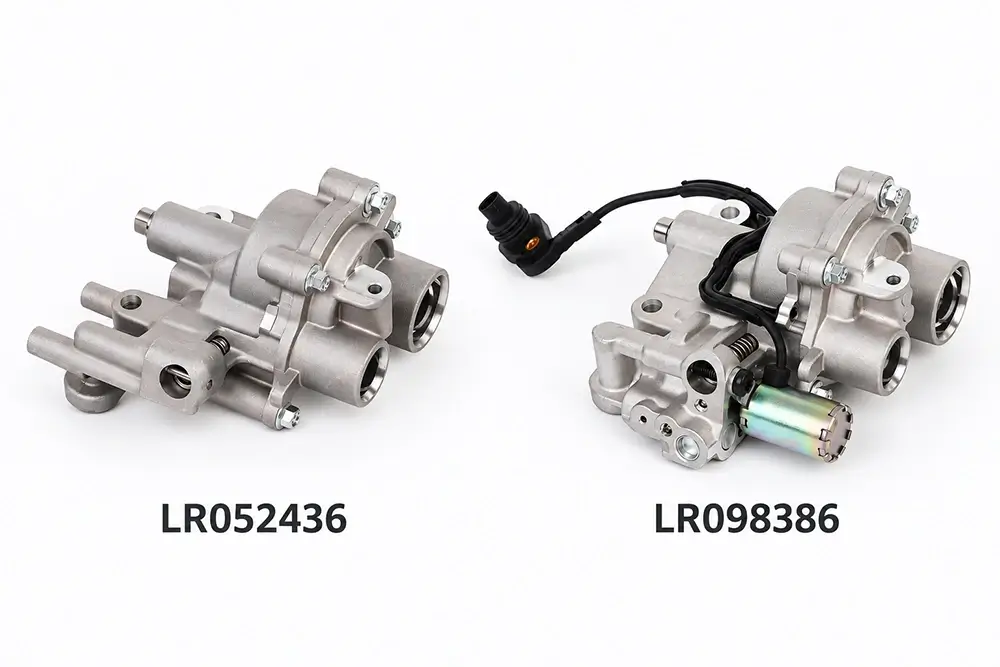
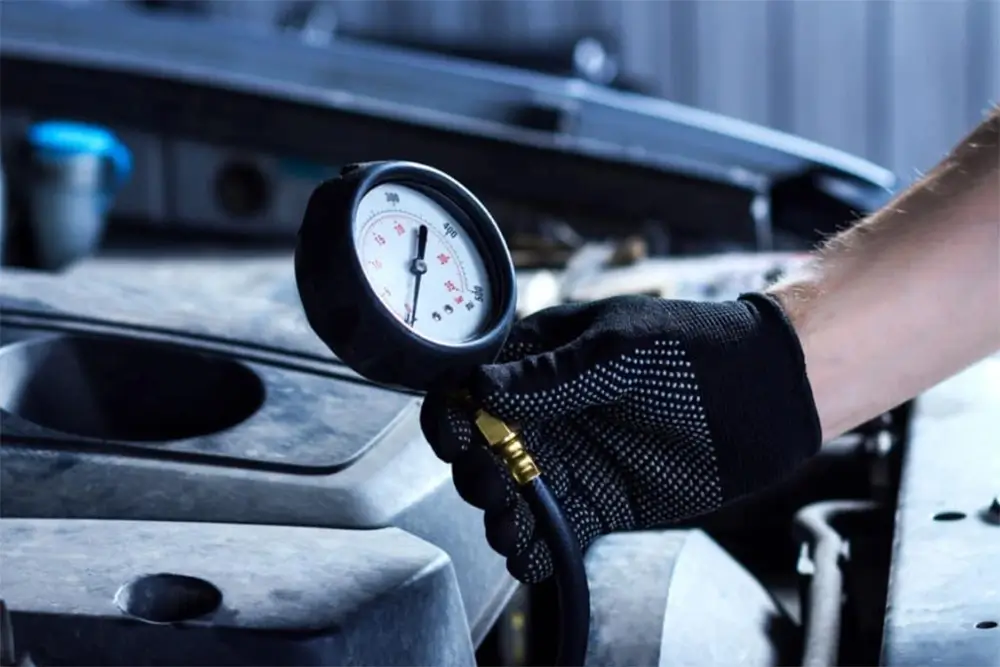
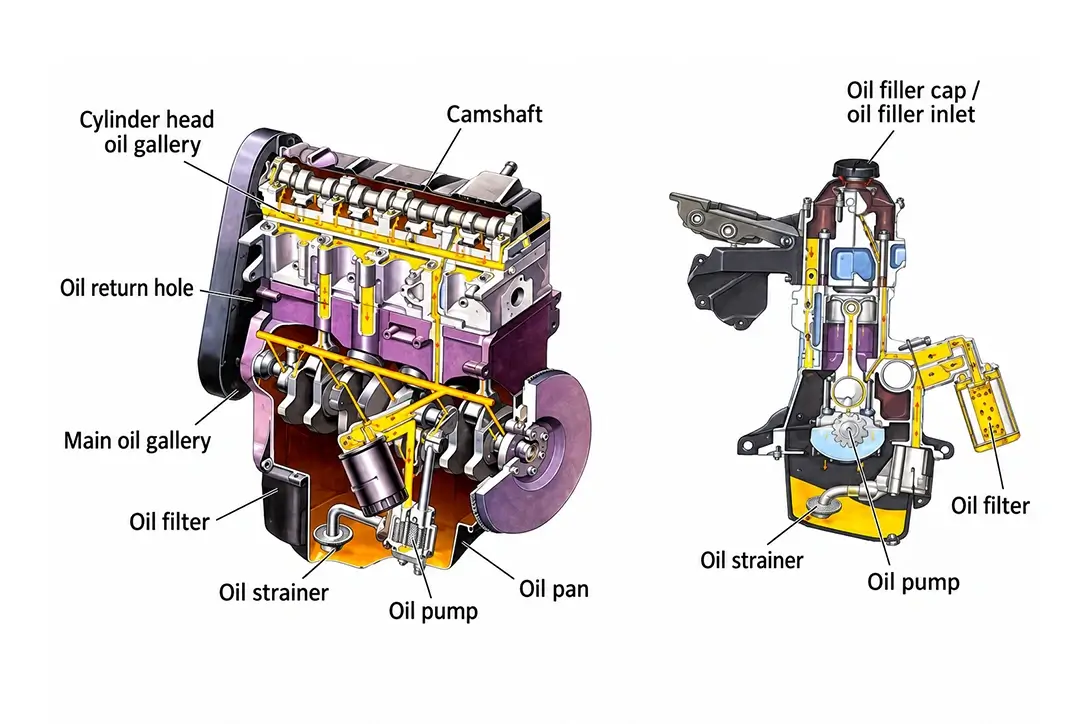
A variable-displacement engine oil pump does more than simply rotate faster as engine speed increases.
Its effective pumping capacity can be changed according to the lubrication demand of the engine. Depending on the system design, the pump may use hydraulic control, a pressure-control valve, an electrically controlled solenoid, or a combination of these elements to change its displacement.
This creates an important parts-identification issue:
the oil pump, control valve and solenoid are related components, but they are not necessarily the same part.
For engine-parts buyers, identifying which component is actually required is essential before an OE-reference replacement is approved.
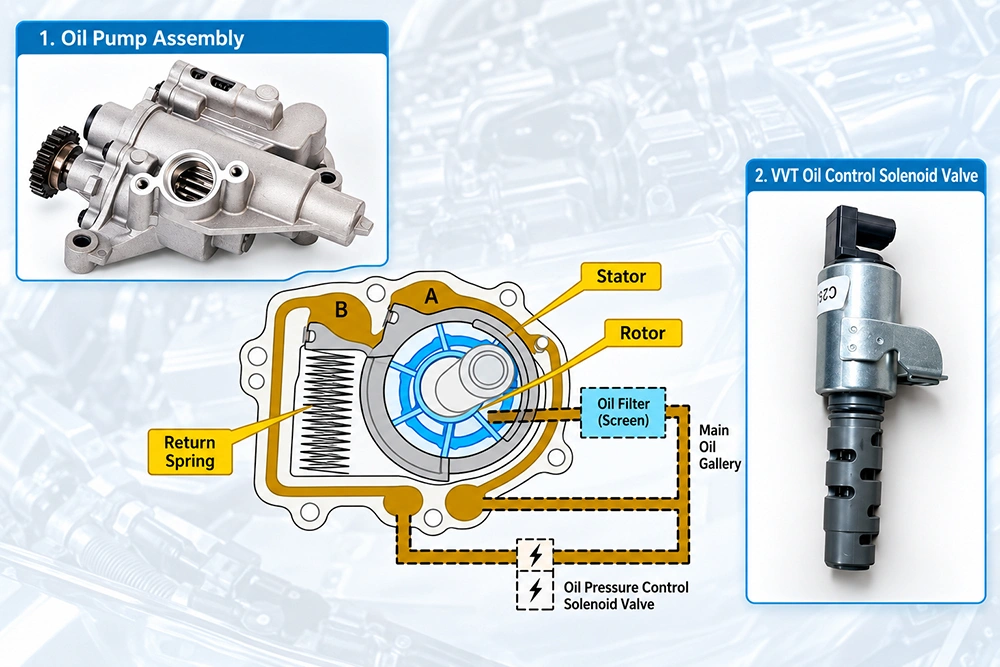
Variable-Displacement Oil Pump vs Control Valve vs Solenoid
| Component | Main function | Typical role |
|---|---|---|
| Variable-displacement oil pump | Moves engine oil and changes effective pumping displacement | Main lubrication pump |
| Control valve | Routes or regulates hydraulic pressure used to change pump displacement | Hydraulic control element |
| Solenoid | Converts an electrical ECU command into valve movement | Electrical actuator |
| Oil-pressure sensor | Measures actual system pressure and reports it to the control system | Feedback sensor |
These components may be:
- integrated into one pump assembly;
- mounted separately;
- connected hydraulically;
- controlled electronically;
- supplied individually or only as part of a larger assembly.
That is why the product name alone is not enough for sourcing.
What Is a Variable-Displacement Oil Pump?
A conventional fixed-displacement positive-displacement pump moves a broadly fixed volume of oil per revolution, subject to internal leakage and system conditions.
A variable-displacement pump can change the effective volume moved per revolution.
The objective is not simply to create “more pressure”.
It is to avoid pumping more oil than the engine requires under conditions where lower pump output is sufficient.
Reducing unnecessary pumping work can reduce parasitic power consumption.
How Does a Variable-Displacement Oil Pump Change Output?
The exact mechanism depends on the pump design.
One common variable-vane arrangement includes:
- a drive shaft;
- rotor;
- vanes;
- movable cam ring or stator;
- control chamber;
- return spring;
- control valve;
- solenoid or pilot valve.
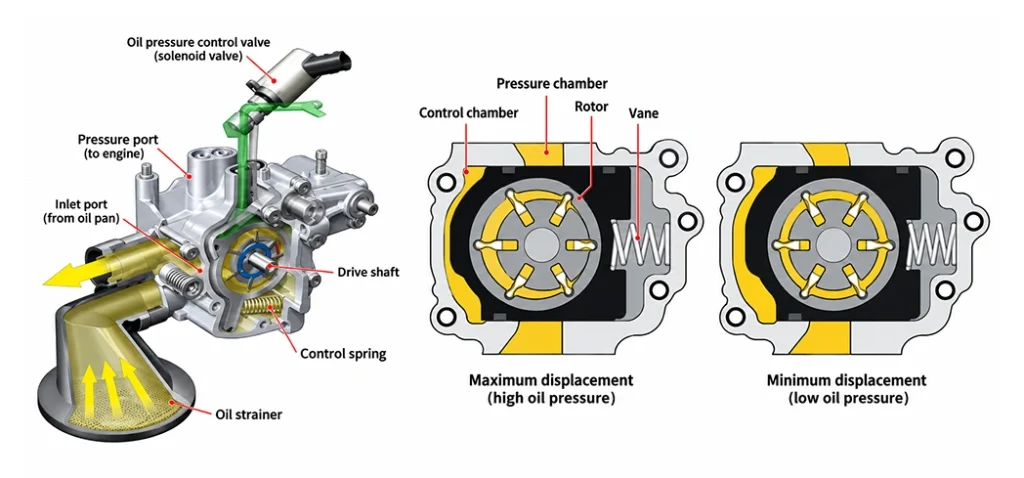
In simplified form:
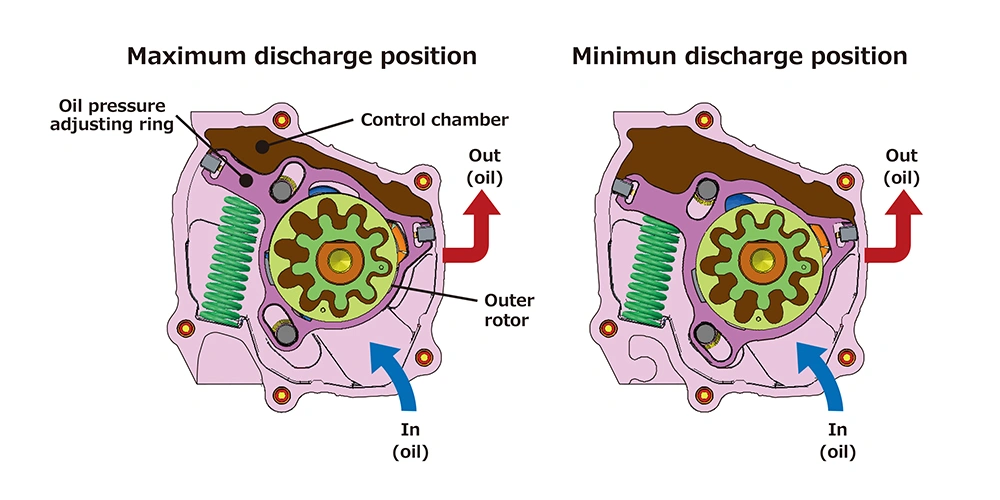
More eccentricity → larger effective pumping chambers → greater displacement
Less eccentricity → smaller effective pumping chambers → lower displacement
The important point is that the pump geometry itself changes.
This is fundamentally different from simply dumping excess pressure through a conventional relief valve.
Variable-Displacement Pump vs Fixed-Displacement Pump
| Feature | Fixed-displacement oil pump | Variable-displacement oil pump |
|---|---|---|
| Displacement per revolution | Broadly fixed | Adjustable |
| Main output relationship | Strongly linked to pump speed | Pump speed + displacement control |
| Pressure regulation | Primarily relief/regulator strategy | Relief plus variable-control strategy |
| Control components | Usually simpler | May include hydraulic valve, solenoid and control chamber |
| ECU involvement | Often limited or none | Can be significant on electronically controlled systems |
| Identification complexity | Lower | Higher |
A variable-displacement design adds another control layer by changing effective pump output.
What Does the Oil Pump Control Valve Do?
The control valve manages hydraulic pressure or oil routing used to change pump displacement.
Depending on the design, it may control pressure to:
- a cam-ring chamber;
- a stator-control chamber;
- a pump actuator;
- a pilot circuit;
- another hydraulic control element.
The valve does not necessarily create the oil flow itself.
Its role is to determine how control pressure acts on the pump mechanism.
A control valve may be:
- mechanically pressure-operated;
- hydraulically piloted;
- electrically actuated;
- combined with a solenoid;
- integrated inside the pump assembly.
The exact architecture must therefore be confirmed before replacement.
What Does the Oil Pump Solenoid Do?
The solenoid is the electrical actuator in an electronically controlled system.
The ECU or engine-control unit sends an electrical command to the solenoid.
The solenoid then moves:
- a spool valve;
- pilot valve;
- hydraulic control valve;
- or another regulating element.
That changes the hydraulic control pressure acting on the pump mechanism.
A useful simplified sequence is:
ECU command → solenoid → control valve / hydraulic circuit → pump control chamber → displacement change
The solenoid does not normally perform the pumping action.
The rotating pump mechanism still moves the engine oil.
Is the Control Valve the Same as the Solenoid?
Not always.
This terminology causes significant confusion in catalogues.
In some designs, the electrical solenoid and hydraulic spool valve are packaged together and sold as one:
oil pump control solenoid valve
In other designs:
- the solenoid is one component;
- the pilot/control valve is another;
- the pump contains additional hydraulic regulation internally.
Therefore:
“control valve”, “solenoid” and “solenoid valve” should not automatically be treated as interchangeable catalogue terms.
OE reference and physical design should decide the match.
How the ECU Can Control Pump Output
An electronically controlled system may use several inputs.
Depending on the engine, these can include:
- oil pressure;
- oil temperature;
- coolant temperature;
- engine RPM;
- engine load;
- VVT demand;
- operating mode.
One possible control loop is:
- The ECU calculates required lubrication demand.
- The oil-pressure sensor reports actual system pressure.
- The ECU commands the oil-pump solenoid.
- The solenoid changes hydraulic routing.
- The pump changes displacement.
- Oil pressure changes.
- The ECU compares actual and required conditions again.
Not every engine uses exactly this architecture.
Low-Pressure Mode and High-Pressure Mode
Variable-displacement pumps may operate using two or more target modes.
For example:
- lower displacement during operating conditions where less oil flow is required;
- higher displacement when greater lubrication demand exists.
But the electrical command strategy is not universal.
This is one of the most important points for parts diagnosis.
One Design May Use
solenoid energised → high-pressure mode
Another Design May Use
solenoid energised → low-pressure mode
Therefore, diagnosis must not use a universal assumption about whether “ON” means high or low displacement.
The electrical state, hydraulic routing and fail-safe mode vary by engine design. Always confirm the application-specific control strategy.
Why Variable Oil Pumps Are Used
The engine does not need the same oil flow under every operating condition.
Modern lubrication demand can vary with:
- RPM;
- temperature;
- bearing requirements;
- piston cooling;
- turbocharger lubrication;
- hydraulic valve operation;
- VVT systems;
- engine load.
This is the main engineering advantage over continuously operating a pump at maximum effective displacement.
Pressure-Relief Valve vs Variable-Displacement Control Valve
These two should also not be confused.
Pressure-Relief Valve
Primarily protects or regulates the lubrication circuit when pressure exceeds the intended limit.
Variable-Displacement Control Valve
Changes the hydraulic state that determines the pump’s effective displacement.
A conventional pump can contain a pressure-relief valve without being a variable-displacement pump.
In contrast, a variable pump alters pump output itself.
Some systems contain both mechanisms.
Variable-Displacement Oil Pump System Diagram
A useful generic system diagram is:
Oil sump
↓
Pickup / strainer
↓
Variable-displacement pump
↓
Oil filter
↓
Main oil gallery
↓
Bearings / valve train / VVT / turbo lubrication
Control side:
Oil-pressure sensor → ECU → solenoid → control valve → pump control chamber
Generic control architecture. Actual hydraulic routing varies by engine design.
Common Variable Oil Pump Control Architectures
Hydraulic-Only Control
Pump displacement changes mainly according to hydraulic pressure acting on a control element.
There may be no separately commanded electrical solenoid.
Solenoid-Switched Multi-Stage Control
The ECU switches a valve between two hydraulic states.
This may create:
- lower-pressure mode;
- higher-pressure mode.
Proportional Electronic Control
A PWM or current-controlled solenoid changes hydraulic control more progressively.
Integrated Pump-Control Assembly
The solenoid, spool valve and hydraulic passages may all be built into the pump housing.
These architectures should not be assumed interchangeable.
Can the Solenoid Be Replaced Separately?
Sometimes.
But not always.
Depending on the application, the control component may be supplied as:
- solenoid only;
- solenoid valve assembly;
- control valve only;
- pump with integrated control valve;
- complete oil pump assembly.
This is a commercial-sourcing issue as much as a technical one.
Before quotation, confirm what the buyer actually needs.
Can a Faulty Solenoid Cause Low Oil Pressure?
Potentially, depending on the system architecture.
A failed electrical or hydraulic control element may prevent the pump from reaching the required displacement state.
However, low oil pressure can also involve:
- low oil level;
- incorrect viscosity;
- blocked pickup;
- pickup seal leakage;
- worn pump internals;
- excessive bearing clearance;
- pressure-sensor error;
- wiring fault;
- pressure-control valve fault.
Therefore:
Low oil pressure does not prove that the oil-pump solenoid is defective.
For pressure-pattern diagnosis, see Low Oil Pressure at Idle vs Under Load.
Can the Pump Be Bad if the Solenoid Works?
Yes.
Correct solenoid operation does not prove that the pump mechanism is healthy.
The pump can still have:
- rotor or vane wear;
- housing wear;
- damaged cam ring;
- sticking internal mechanism;
- worn drive interface;
- internal leakage;
- contamination.
Likewise, replacing the complete pump may not solve an electrical control fault outside the pump.
How to Identify a Variable-Displacement Oil Pump
Do not identify it only from the external housing.
Check:
- OE reference;
- engine code;
- housing shape;
- drive interface;
- inlet and outlet location;
- control chamber arrangement;
- control-valve port;
- solenoid connector;
- number of electrical terminals;
- mounting position;
- front and rear pump photographs;
- included control components.
Two pumps can appear similar but use different hydraulic or electrical control strategies.
For a wider structural overview, see Engine Oil Pump Structure: Diagram, Parts and Assembly Types.
Control Valve and Solenoid Identification
For the control component, check:
- complete OE number;
- electrical connector;
- terminal count;
- valve-body length;
- spool or nose design;
- O-ring position;
- oil-port location;
- mounting flange;
- thread or retaining method;
- pump application.
Do not confirm interchangeability from connector appearance alone.
B2B Matching Checklist
| Required information | Why it matters |
|---|---|
| OE number | Primary reference identity |
| Engine code | Confirms engine generation |
| Pump housing | Confirms physical architecture |
| Drive interface | Confirms mechanical compatibility |
| Solenoid provision | Identifies electronic control |
| Connector and pin count | Helps distinguish control versions |
| Control valve included? | Defines supplied scope |
| Pressure-control design | Avoids confusing relief and displacement control |
| Front/rear photographs | Identifies passage and housing differences |
| Quantity | Commercial quotation requirement |
Pump Only vs Pump with Control Valve
One of the most common sourcing errors is assuming the pump includes every control component visible in catalogue photographs.
A quotation should specify whether the supplied product includes:
- pump body;
- pump housing;
- control valve;
- solenoid;
- relief valve;
- pickup;
- seals;
- mounting hardware.
Do not infer assembly scope from the product name alone.
Frequently Asked Questions
What Is a Variable-Displacement Oil Pump?
It is an engine oil pump whose effective pumping displacement can change according to the lubrication-system control strategy rather than remaining fixed per revolution.
What Controls a Variable Oil Pump?
Depending on the design, control may use hydraulic pressure, a pilot valve, control valve, ECU-controlled solenoid, or a combination of these components.
Is an Oil Pump Control Valve the Same as the Solenoid?
Not always. A solenoid is the electrical actuator. A control valve manages hydraulic flow or pressure. They may be combined into one solenoid-valve assembly or supplied separately.
Does the Solenoid Directly Pump the Oil?
No. The pump’s rotating mechanism moves the oil. The solenoid changes the control state that determines pump displacement.
Does Energising the Solenoid Always Increase Oil Pressure?
No. The control logic varies by engine and pump architecture. Some systems use energised state for lower output, while others use it for higher output.
Is a Pressure-Relief Valve the Same as a Variable-Pump Control Valve?
No. A relief valve primarily limits excessive pressure. A displacement-control valve changes the hydraulic control state of a variable pump. Some pumps contain both.
Can a Variable Oil Pump Operate Without an Electronic Solenoid?
Yes. Some variable designs use primarily hydraulic or mechanical control.
Can the Oil-Pump Solenoid Be Replaced Separately?
Sometimes. Other applications integrate it into the pump or sell it only as part of a larger assembly. Confirm the OE reference and supplied scope.
Variable-Displacement Oil Pump Sourcing
For variable-displacement oil pump enquiries, send Wellgine:
- complete OE reference;
- engine code;
- vehicle application;
- pump front and rear photographs;
- control-valve / solenoid photographs;
- connector details;
- required assembly scope;
- quantity.
Wellgine supplies selected engine oil pumps and oil-pump assemblies for international aftermarket and B2B sourcing.