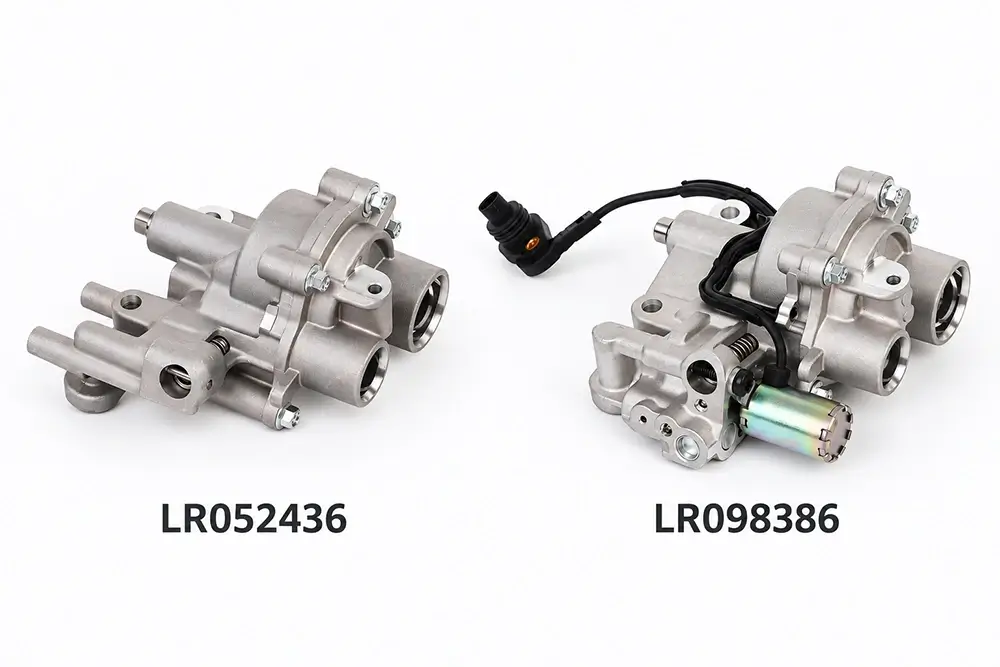
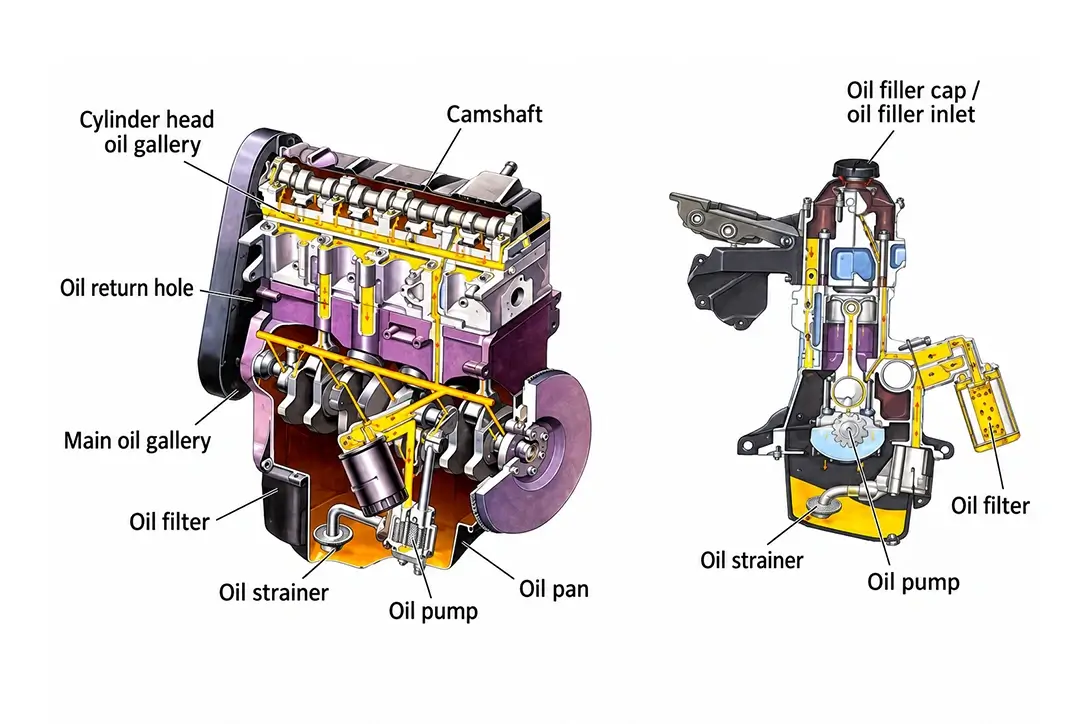
Jaguar Land Rover Ingenium engines use several separate but related systems to manage lubrication and engine temperature. For parts buyers, three components can easily become mixed together in technical enquiries: the engine oil pump, the piston oil cooling solenoid and the electric water pump.
They do not perform the same function and they do not circulate the same fluid.
The oil pump belongs to the engine lubrication circuit. A piston cooling solenoid, where fitted, controls a specific branch of that oil circuit associated with piston cooling. An electric water pump belongs to the coolant circuit and circulates engine coolant rather than lubricating oil.
Understanding these relationships helps distributors, engine rebuilders and procurement teams identify the correct component before matching an OE-reference replacement part.
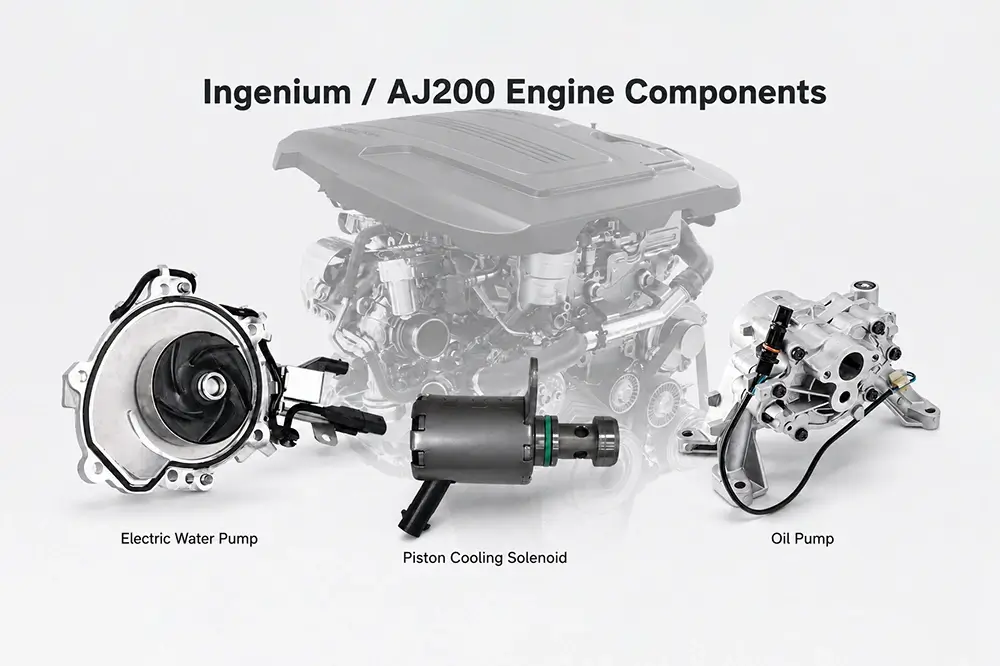
AJ200 Oil and Cooling Systems at a Glance
A useful starting point is to separate the engine into two fluid systems:
Engine oil circuit
Oil sump → oil pump → pressurised oil galleries → lubrication points and controlled oil branches → return to sump
Depending on the engine configuration, these branches can supply components such as bearings, camshaft and timing-system lubrication, turbocharger lubrication and piston cooling.
Engine coolant circuit
Coolant pump → engine coolant passages → heat-management components → radiator and related cooling circuit → pump
These circuits work together to manage engine operating conditions, but they remain physically and functionally different systems.
This distinction is especially important when an enquiry uses broad descriptions such as “cooling pump”, “oil cooling valve” or “engine cooling solenoid”. The name alone may not identify the correct part.
Where Is the Piston Cooling Solenoid Located in the AJ200 Oil Circuit?
The piston cooling solenoid belongs to the engine-oil circuit rather than the coolant circuit. Functionally, it is positioned in a controlled branch between the pressurised engine-oil supply and the oil jets used to cool the pistons.
A simplified functional path is:
oil sump → engine oil pump → pressurised oil gallery → piston cooling solenoid → piston cooling oil jets
The oil pump first supplies pressurised oil to the engine lubrication system. Where the applicable AJ200 configuration uses controlled piston cooling, the solenoid regulates oil delivery through the branch serving the piston cooling jets. It does not circulate engine coolant and it does not perform the same function as the electric water pump.
The exact physical installation position can vary by Ingenium engine version and vehicle application. For this reason, the component should not be identified from a general location description alone. Buyers should confirm the OE reference, engine code, electrical connector, valve-body structure and original-part photographs before ordering.
Oil Pump: The Supply Component of the Lubrication Circuit
The engine oil pump provides the oil flow required by the lubrication system.
Oil is drawn from the sump and delivered into the engine’s pressurised oil passages. From there, oil is distributed to the lubrication points defined by the particular engine design.
The oil pump should therefore be understood as the supply component, rather than as a valve dedicated to one downstream function.
This is important when distinguishing it from the piston oil cooling solenoid.
An oil pump:
- generates and circulates engine oil flow;
- supplies the main lubrication circuit;
- forms part of the engine’s overall oil-pressure system;
- may serve several downstream lubrication functions.
A piston cooling solenoid, by contrast, controls a particular oil-flow branch where that architecture is used.
For general pump construction and matching principles, see Wellgine’s guide to engine oil pump structure.
LR087668 as an AJ200 Oil-Pump Reference
Wellgine lists LR087668 as an OE-reference oil-pump product associated with selected Jaguar Land Rover Ingenium applications.
The important point in this system guide is not to treat LR087668 as the universal oil pump for every AJ200 engine.
Before ordering, confirm:
- OE reference;
- engine code;
- vehicle application;
- production information where required;
- pump housing and mounting configuration;
- and the original component being replaced.
Different Ingenium versions and production configurations should not be assumed to use an identical oil-pump assembly.
Piston Cooling Solenoid: A Control Component within the Oil Circuit
The piston oil cooling solenoid is not another oil pump.
In engine designs that use controlled piston cooling, the solenoid is associated with the oil-flow path serving the piston cooling circuit or piston oil jets.
The simplified relationship is:
Oil pump → pressurised oil gallery → piston cooling control → piston cooling oil delivery
This distinction explains why the two components can appear in the same technical discussion while serving different functions.
The oil pump provides the oil supply.
The piston cooling solenoid controls a specific oil branch.
For a detailed explanation of piston cooling jets, oil galleries, valve structure and identification differences, see the Piston Oil Cooling Solenoid Guide.
This AJ200 system guide intentionally does not repeat that single-component explanation in full.
LR073684 in the Piston Cooling Circuit
Wellgine lists LR073684 as an OE-reference piston oil cooling solenoid for selected Ingenium engine applications.
From a sourcing perspective, LR073684 should be identified by more than its general appearance.
Check:
- OE number;
- engine code;
- electrical connector;
- valve-body configuration;
- mounting point;
- inserted section and oil-port arrangement;
- and the original installed component.
A piston cooling valve should not be selected simply because it resembles a VVT solenoid, oil-pump control valve or another cylindrical engine solenoid.
Oil Pump and Piston Cooling Solenoid Are Related — but Not Interchangeable
The easiest way to understand the relationship is to separate supply from control.
| Component | Fluid | System role | Main sourcing risk |
|---|---|---|---|
| Engine oil pump | Engine oil | Supplies oil flow to the lubrication circuit | Assuming one pump fits every AJ200 variant |
| Piston oil cooling solenoid | Engine oil | Controls a piston-cooling oil branch where fitted | Confusing it with VVT or another oil-control solenoid |
| Electric water pump | Engine coolant | Circulates coolant within a cooling circuit | Confusing coolant-system and oil-system components |
This is also why an oil-pressure complaint, piston-cooling control issue and coolant-temperature complaint should not automatically be treated as the same fault.
The components may contribute to overall engine thermal management, but they operate in different circuits.
Electric Water Pump: Part of the Coolant Circuit, Not the Oil Circuit
An electric water pump circulates coolant rather than engine oil.
Its basic role is to move coolant through the cooling circuit so that heat can be transferred away from the engine and rejected through the vehicle’s cooling system.
Unlike a mechanically driven pump whose speed is directly tied to engine rotation, an electrically driven pump can operate according to the control strategy used by the particular vehicle.
That distinction gives the electric pump a different diagnostic and sourcing profile from both the oil pump and the piston cooling solenoid.
An electric coolant pump may involve:
- electrical supply;
- ground;
- control or communication;
- commanded pump operation;
- pump response;
- and actual coolant circulation.
For failure diagnosis, see Electric Water Pump Failure Symptoms: Electrical Faults, Coolant Flow and Diagnostic Checks.
LR123906 as an Electric Water-Pump Reference
Wellgine lists LR123906 as an OE-reference electric water-pump product associated with selected Jaguar Land Rover Ingenium applications.
It should not be interpreted as the coolant equivalent of LR087668.
The two pumps move different fluids and belong to different circuits:
LR087668 reference
Engine lubrication / oil-pump function
LR123906 reference
Engine coolant / electric water-pump function
Product matching should still be based on the exact application rather than the general AJ200 engine-family name alone.
For broader Jaguar and Land Rover coolant-pump sourcing, buyers can review Wellgine’s Jaguar Land Rover Water Pumps range.
How the Oil and Coolant Circuits Work Together
The oil and coolant circuits should not be drawn as one continuous flow path.
They are separate systems, but both contribute to controlling operating temperature and protecting engine components.
The oil circuit
The oil system primarily provides lubrication and oil-based heat transfer.
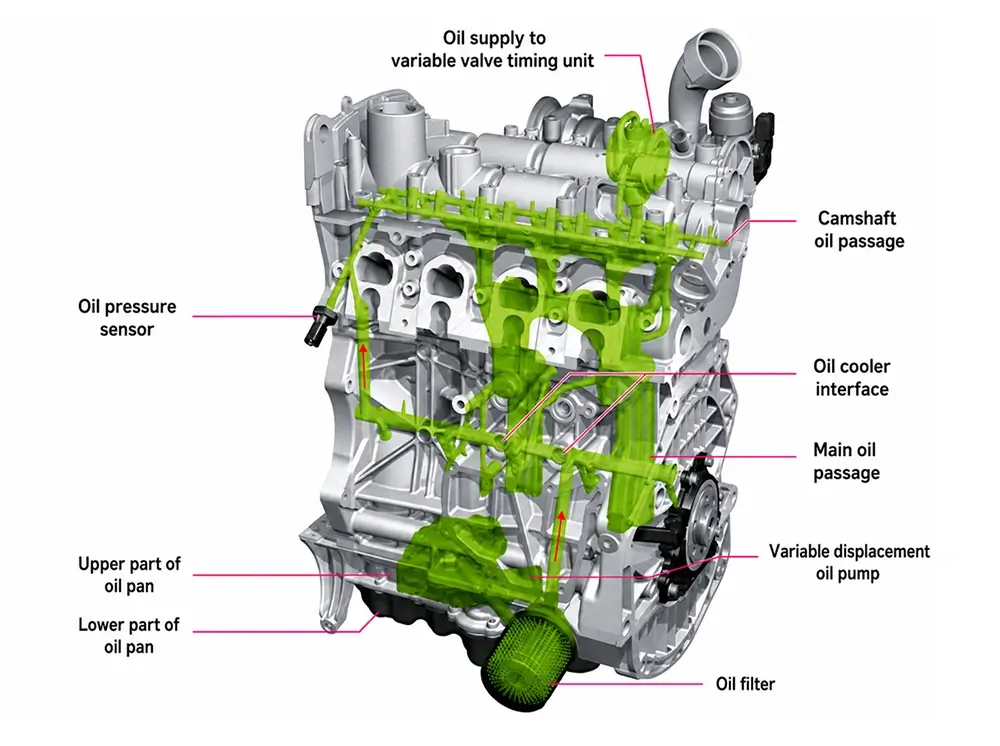
The oil pump supplies oil through the engine lubrication passages. Where controlled piston cooling is used, part of that oil supply can be directed through a dedicated piston-cooling branch.
Oil delivered towards the piston area can remove heat while also serving the lubrication and thermal requirements defined by the engine design.
The coolant circuit
The coolant system removes heat through coolant passages and external heat exchangers.
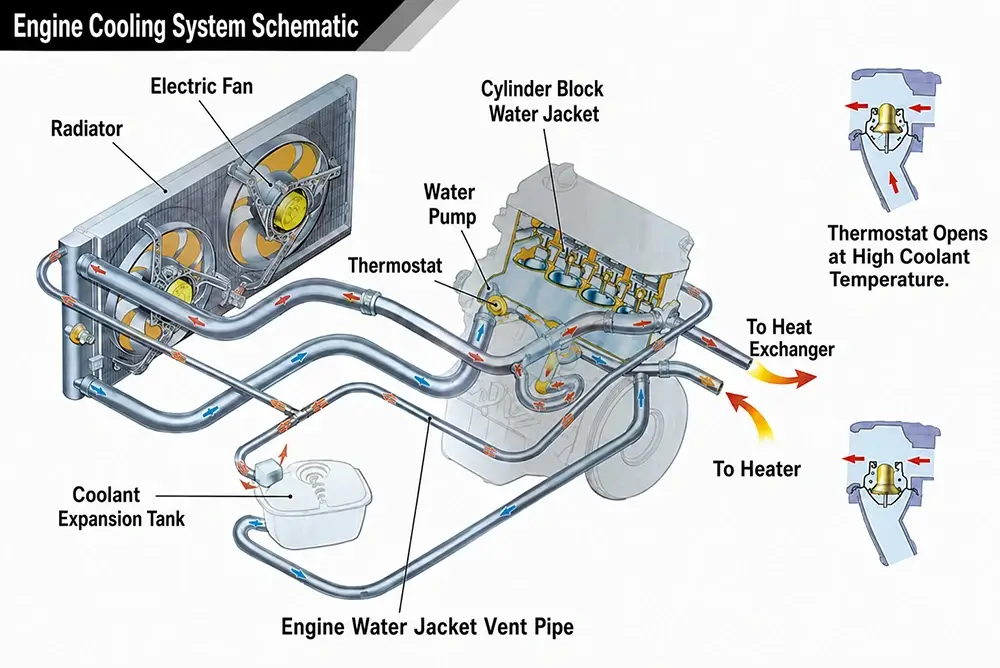
The water pump circulates coolant through the relevant cooling paths. The coolant then carries heat towards the radiator or other parts of the thermal-management circuit.
The relationship
A simplified system view is therefore:
Lubrication side
Oil sump
↓
Oil pump
↓
Main oil circuit
↓
Piston cooling branch / other lubrication branches
↓
Oil returns to the sump
Cooling side
Electric water pump
↓
Engine coolant passages
↓
Cooling-system components
↓
Radiator / heat rejection
↓
Coolant recirculation
The two systems manage different fluids but both influence engine thermal conditions.
Why System-Level Identification Matters for AJ200 Parts Buyers
An engine-family name is useful, but it is not sufficient for precise part matching.
“Jaguar Land Rover Ingenium AJ200” can refer to multiple engine and vehicle configurations. Production changes, petrol and diesel variants, power output, vehicle installation and market specification can affect the exact component used.
For that reason, procurement should move from broad identification to specific confirmation.
A practical sequence is:
- Identify the required system: lubrication or coolant.
- Identify the component role: pump, control valve or coolant pump.
- Record the OE number on the original part.
- Confirm the engine code.
- Confirm the vehicle application and production information.
- Compare connector and housing structure.
- Check superseded or cross-reference numbers where applicable.
- Confirm the final application before ordering.
This process reduces the risk created by similar terminology and visually similar components.
Do Not Identify the Three Components by the Word “Cooling”
One of the most common terminology problems is the word cooling.
A piston oil cooling solenoid contains “cooling” in its name, but it controls engine oil.
An electric water pump is a cooling-system component, but it circulates coolant.
The oil pump can contribute indirectly to engine thermal management because oil carries heat, but its main system role remains engine lubrication and oil supply.
Therefore:
Piston oil cooling does not mean coolant circulation.
Electric water-pump operation does not mean oil-pressure control.
Oil-pump operation does not replace a piston-cooling control valve.
Keeping these functions separate makes OE identification much clearer.
Component Identification Summary
| Identification question | Oil pump | Piston cooling solenoid | Electric water pump |
|---|---|---|---|
| Main fluid | Engine oil | Engine oil | Coolant |
| Main role | Supply oil flow | Control a piston-cooling oil branch | Circulate coolant |
| Electrical connector required? | Depends on pump design | Yes, for an electrically controlled solenoid | Yes for an electric pump |
| Key structural checks | Housing, drive/mounting, oil passages | Connector, valve body, oil ports, inserted section | Connector, coolant ports, housing orientation |
| Example Wellgine OE reference | LR087668 | LR073684 | LR123906 |
| Confirm application before order? | Yes | Yes | Yes |
The OE references above are examples associated with selected Wellgine product listings. They should not be interpreted as proof that every AJ200 engine uses all three components in the same configuration.
What Information Should Buyers Send for AJ200 Component Matching?
For B2B replacement-part confirmation, provide as much of the following information as possible:
- requested component type;
- OE reference;
- engine code;
- vehicle model;
- production year or other production information where relevant;
- VIN where appropriate for application checking;
- photograph of the original component;
- connector photograph;
- mounting or installed-position photograph where identification is uncertain;
- required quantity;
- and any cross-reference numbers already available.
This information is more useful than an enquiry that only says “AJ200 oil pump” or “Ingenium cooling valve”.
AJ200 Oil and Cooling Circuit: The Key Distinction
The easiest way to understand the system is to remember three roles:
The oil pump supplies.
It provides oil flow to the lubrication system.
The piston cooling solenoid controls.
Where fitted, it manages a specific oil branch associated with piston cooling.
The electric water pump circulates coolant.
It belongs to the cooling circuit rather than the lubrication circuit.
For Jaguar Land Rover Ingenium sourcing, these relationships are useful for identifying the system involved, but final replacement selection should always return to the OE reference, engine code, vehicle application and original component structure.
Wellgine supports OE-reference matching for engine oil pumps, piston oil cooling solenoids and Jaguar Land Rover water pumps for aftermarket distribution and professional parts sourcing.