Camshaft phasers can look similar while differing in intake or exhaust position, engine application, oil-passage layout, rear mounting face or supplied-set scope. Selecting by catalogue name or front appearance alone can result in the wrong quotation or replacement part.
To identify the correct camshaft phaser, confirm the OE number, engine code, intake or exhaust position, bank where applicable, gear profile, centre bore, oil passages, front and rear mounting faces and whether the requirement is for one unit, a pair or a complete adjuster set.
Quick Answer: How to Identify the Correct Camshaft Phaser
A correct camshaft phaser should be confirmed by combining application data with physical structure. The most important checks are:
- OE reference, engine code and vehicle application
- Intake or exhaust position and Bank 1 or Bank 2 where applicable
- Gear or sprocket profile and visible markings
- Centre bore, oil passages and rear mounting face
- Front, rear and side-profile product photographs
- Single phaser, intake/exhaust pair or complete adjuster-set scope
No single detail confirms a match. A similar gear face does not prove that the rear mounting face or oil passages are the same, while one OE reference may still require confirmation of intake/exhaust position and supplied scope.
Need to confirm a camshaft phaser before ordering? Send the OE number, engine code, intake or exhaust position, front and rear photographs and required quantity.
What Is a Camshaft Phaser?
In a car, a camshaft phaser—also called a camshaft phasing unit or camshaft adjuster in some catalogues—is a variable valve timing component that changes the angular position of the camshaft relative to the timing drive.
Cam phasing is the process of advancing or retarding camshaft timing within the system’s designed adjustment range. In many hydraulic VVT systems, the VVT solenoid controls oil flow while the camshaft phaser performs the timing adjustment. Buyers who need the difference between these two components can review Wellgine’s guide to the difference between a VVT solenoid valve and a camshaft phaser.
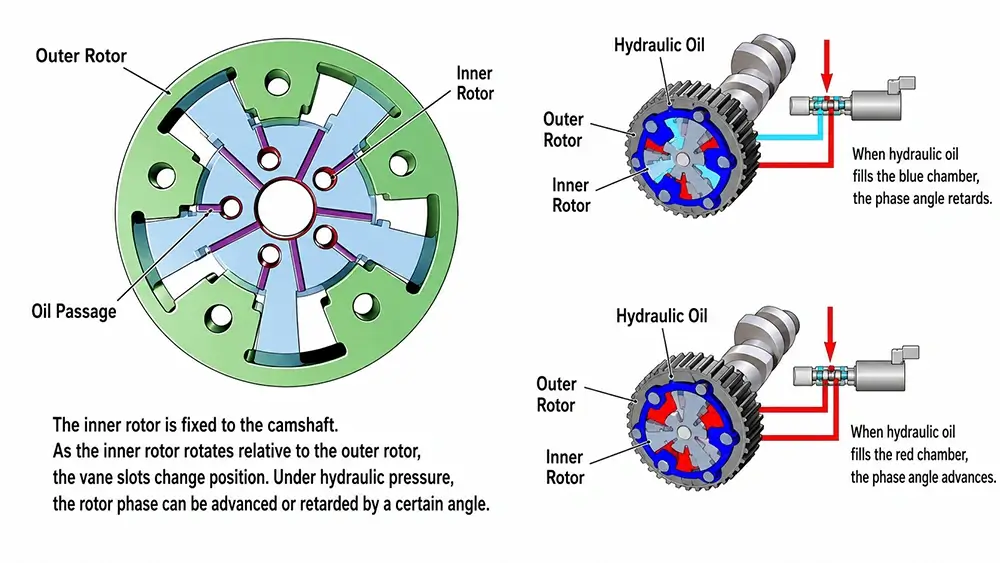
For sourcing purposes, the most important question is not only “what is a camshaft phaser?” but “which camshaft phaser does this engine, position and supplied scope require?” For a wider explanation of how the engine control system, oil-control valve and phaser work together, review our variable valve timing system guide.
Camshaft Phaser, Adjuster, VVT Gear and Solenoid: Name Differences
Camshaft phasers are described differently across vehicle manufacturers, aftermarket catalogues and regional markets. Names can help identify the product family, but they should not replace OE and structure confirmation.
| Name used in catalogue | What it may mean | What to confirm |
|---|---|---|
| Camshaft phaser | Timing adjustment unit on the camshaft | OE reference, position and structure |
| Camshaft adjuster | Phaser or related timing adjuster unit | Single unit or set scope |
| VVT gear | Phaser with gear or sprocket structure | Gear profile, timing side and mounting face |
| CVVT assembly | Continuous variable valve timing unit | Application, front face and rear face structure |
| Camshaft timing gear | May be a phaser or a fixed timing gear | Whether the part has a VVT adjustment function |
| VVT solenoid valve | Oil-control valve that regulates oil flow to the VVT system | Confirm OE number and connector; do not treat it as a camshaft phaser |
For example, CVVT assembly is a common catalogue term in some Hyundai and Kia applications, while camshaft adjuster is often seen in Mercedes-Benz timing-system enquiries. These names are useful, but the actual part should still be confirmed by position, structure and supplied scope.
Intake, Exhaust and Bank Position: The First Matching Risk
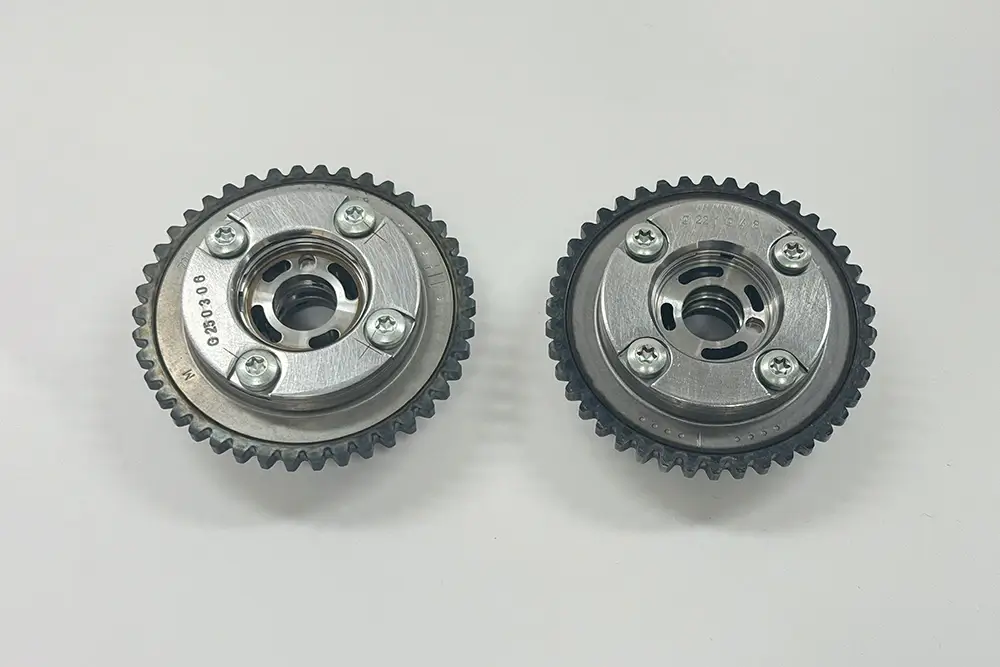
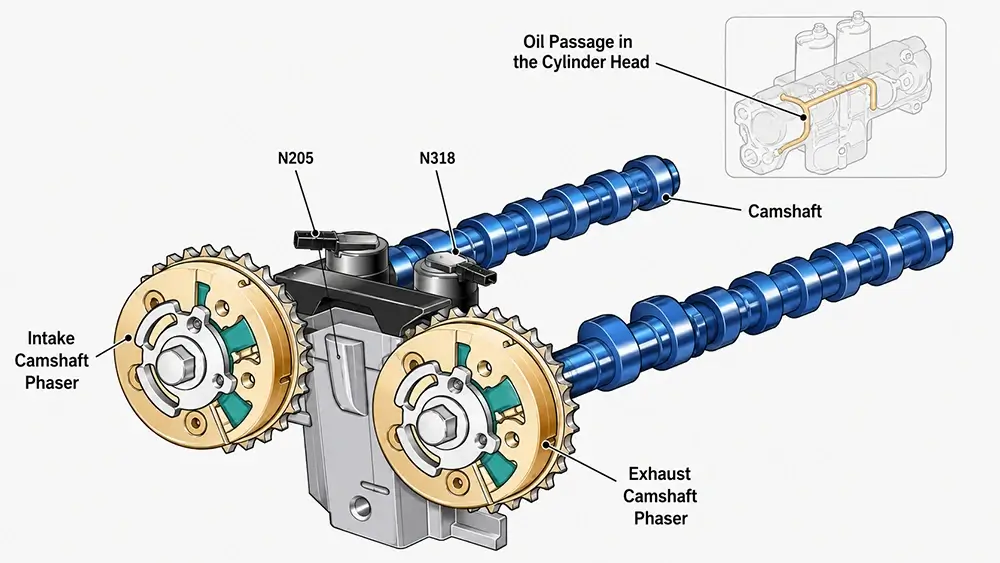
Many engines use separate intake and exhaust camshaft phasers. These parts may appear similar in a front-view photo, but they should not be assumed interchangeable. A practical example is the Mercedes M270/M274 product family, where the A2700506100 intake camshaft phaser and A2700506200 exhaust camshaft adjuster are listed separately. Confirm the required position, OE reference and structure before selecting either unit.
Why intake and exhaust phasers are often confused
Intake and exhaust phasers may share a similar outside diameter, gear profile or general housing shape. However, they may differ in OE reference, oil-passage routing, locking structure, timing range, mounting face or orientation.
If a buyer only states “camshaft phaser” without confirming intake or exhaust position, the supplier may not be able to quote accurately. The enquiry should state the required position wherever the engine uses separate phasers.
Why Bank 1 and Bank 2 matter
On V-type engines, the same engine family may use bank-specific timing components. Bank 1 and Bank 2 should be confirmed according to reliable application data, not guessed from left and right descriptions alone.
Left and right can be interpreted differently depending on viewing direction. Bank position, engine code and OE reference provide a safer basis for matching.
Why vehicle model alone is not enough
A vehicle model may use different engine versions, production revisions or market-specific timing systems. A camshaft phaser enquiry should therefore combine vehicle application with engine code, OE reference and position information.
For general background on camshaft position, buyers can review Wellgine’s guide to intake and exhaust camshaft position.
Single Phaser, Pair or Camshaft Adjuster Set?
The supplied scope is one of the easiest areas to misunderstand. A buyer may request “one camshaft phaser”, while a catalogue image shows two units. Another buyer may request an adjuster set, but only one OE reference is provided.
Before quotation, both buyer and supplier should confirm whether the requirement is for a single unit, an intake and exhaust pair, a bank-specific pair, or a larger camshaft adjuster set.
| Buyer request | Possible meaning | What should be confirmed |
|---|---|---|
| One camshaft phaser | Single intake or exhaust timing unit | Position and OE reference |
| Camshaft adjuster set | Pair or multiple adjusters | Included units and quantity per set |
| VVT gear set | May include intake and exhaust gears | Gear side, engine application and set content |
| Full timing set | May include non-phaser timing parts | Whether phasers are included and how many |
| Left and right adjusters | May refer to bank-specific components | Bank 1, Bank 2 and viewing direction |
A product image does not define the quotation scope. Confirm the number of phasers, intake/exhaust or bank positions and whether bolts or related parts are included. For comparison, review a single 24350-3C100 intake camshaft phaser and a Mercedes M276 intake and exhaust camshaft adjuster set. These examples show why the number of units and supplied scope must be confirmed before ordering.
Structural Checks That Actually Matter
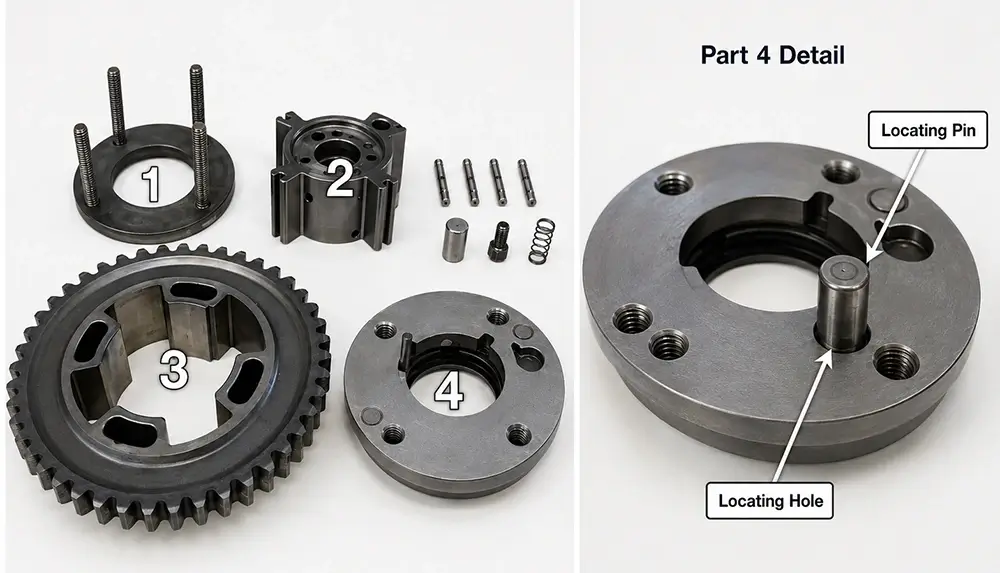
Camshaft phaser matching should focus on the structures that affect timing drive compatibility, camshaft mounting and oil-controlled actuation. A single gear-side image is rarely enough.
| Check point | What to compare | Why it matters |
|---|---|---|
| Gear or sprocket profile | Tooth shape, chain contact area and outer profile | Affects timing drive compatibility |
| Centre bore | Diameter, inner structure and camshaft interface | Affects camshaft mounting |
| Oil passages | Hole number, position and routing | Affects phaser actuation and oil-control function |
| Rear mounting face | Contact surface, depth and mounting structure | Affects installation and fitment |
| Locking structure | Locking pin, stop feature or visible locking design where applicable | Affects timing control behaviour |
| Side profile | Thickness, step design and housing depth | Helps distinguish similar-looking units |
The gear or sprocket profile may look correct while the rear mounting face is different. The centre bore may match while the oil-passage layout does not. This is why buyers should compare both sides and the side profile before treating two phasers as equivalent.
Typical Wrong-Match Scenarios
The buyer sends a VVT solenoid OE number but asks for a phaser
This can happen when a timing-system fault is described without the exact part being identified. A VVT solenoid and a camshaft phaser work in the same broader VVT system, but they are different components. The supplier should confirm whether the enquiry is for the control valve or the timing adjustment unit.
Intake and exhaust phasers look almost identical
Two phasers from the same engine may share a similar gear face. The difference may be on the rear face, oil passages, locking structure or timing position. Intake and exhaust should be confirmed before quotation.
The photo shows only the gear side
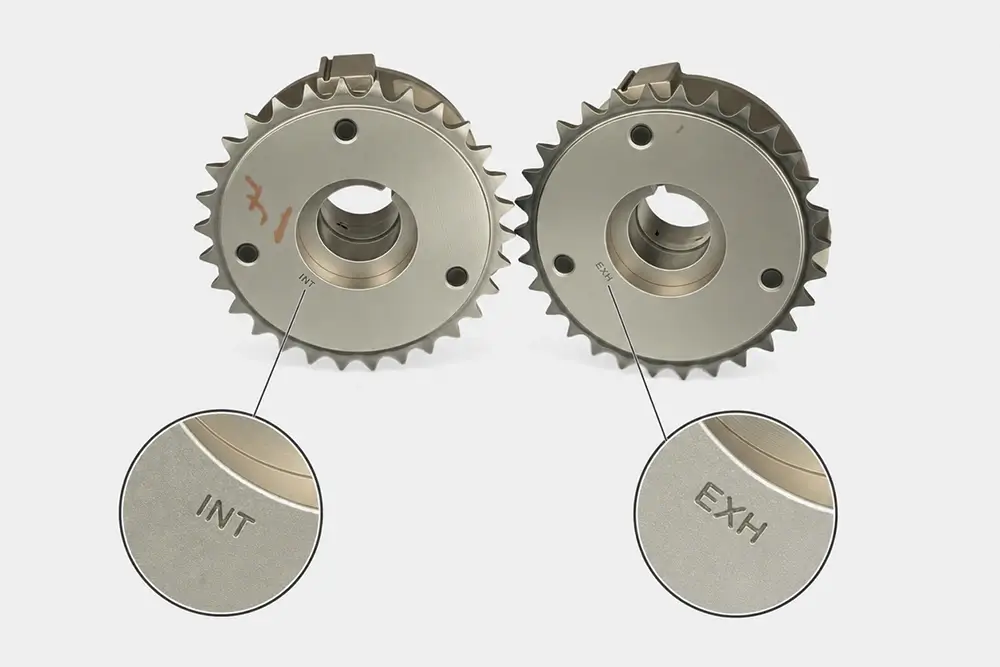
A gear-side photo may confirm the sprocket profile, but it does not confirm centre bore depth, rear mounting face, oil passages or supplied scope. Buyers should provide both front and rear views.
The OE number refers to a set, but the enquiry asks for one unit
Some catalogue references may appear near set descriptions. If the buyer expects a set but the supplier quotes one phaser, the order scope will be wrong. The number of units and positions included should be confirmed.
What Photos Help Confirm a Camshaft Phaser?
For faster review, buyers should send photos that show the part from the angles that matter for phaser matching. These photos are more useful than one general front-view image.
- Gear or sprocket side
- Rear mounting face
- Centre bore and oil passages
- Side profile
- OE number and visible intake/exhaust markings
- Complete pair or set when multiple units are required
If the OE reference is unclear or the part belongs to a set, a side-by-side photo of all units can help confirm whether the enquiry is for one phaser, a pair or a complete adjuster set.
Have these photographs ready? Send them together with the OE reference, engine code, intake or exhaust position and required quantity for application review.
Inspection Focus for Camshaft Phasers
Inspection requirements should follow the confirmed drawing, approved sample, product specification or agreed project requirement. For camshaft phasers, inspection should focus on structures that affect mounting, timing drive and oil-controlled actuation.
Relevant inspection focus may include:
- Product identity and OE-reference confirmation
- Gear profile, centre bore and mounting interface
- Oil passages and visible locking structure
- Machining and assembly condition
- Included bolts, accessories and set scope
- Packaging, label and batch consistency
Buyers can also review Wellgine’s engine parts quality-control process for broader information about inspection, dimensional confirmation and batch order control.
Camshaft Phaser Supply from Wellgine
Wellgine supplies selected camshaft phasers and camshaft adjusters for B2B replacement and sourcing requirements, including selected Hyundai, Mercedes-Benz and Range Rover applications. Available enquiries can be reviewed by OE reference, engine code, intake/exhaust or bank position, front and rear structure, sample details, quantity and packaging requirements.
Frequently Asked Questions
What is a camshaft phaser in a car?
A camshaft phaser is a variable valve timing component that changes the angular position of the camshaft relative to the engine timing drive. It allows the valve timing to be advanced or retarded according to the engine’s control strategy.
What is cam phasing?
Cam phasing is the process of advancing or retarding camshaft timing within the adjustment range designed for the engine. In many hydraulic VVT systems, controlled oil pressure moves the camshaft phaser to change the camshaft position.
Is a camshaft phaser the same as a camshaft adjuster?
In many catalogues, “camshaft phaser” and “camshaft adjuster” refer to the same or a closely related timing-adjustment unit. Terminology varies by manufacturer and market, so buyers should still confirm the OE reference, engine code, intake or exhaust position, physical structure and supplied scope.
Is a camshaft phaser the same as a VVT solenoid?
No. A VVT solenoid regulates oil flow in many variable valve timing systems, while the camshaft phaser uses the controlled oil pressure to change the camshaft timing position. They are separate components and should not be ordered interchangeably.
Can intake and exhaust camshaft phasers be interchangeable?
They should not be assumed interchangeable. Intake and exhaust phasers may differ in OE reference, timing range, oil-passage layout, locking structure, gear profile and rear mounting face. Confirm the engine code, installation position and product structure before ordering.
Conclusion
The correct camshaft phaser should be identified by OE reference, engine code, intake/exhaust or bank position, gear structure, centre bore, oil passages, rear mounting face and supplied scope. Do not confirm a replacement from catalogue terminology or one front-view photograph alone.
Send Wellgine your OE reference, engine code, intake or exhaust position, gear-side photo, rear mounting face photo and required quantity for camshaft phaser matching review and B2B quotation support.