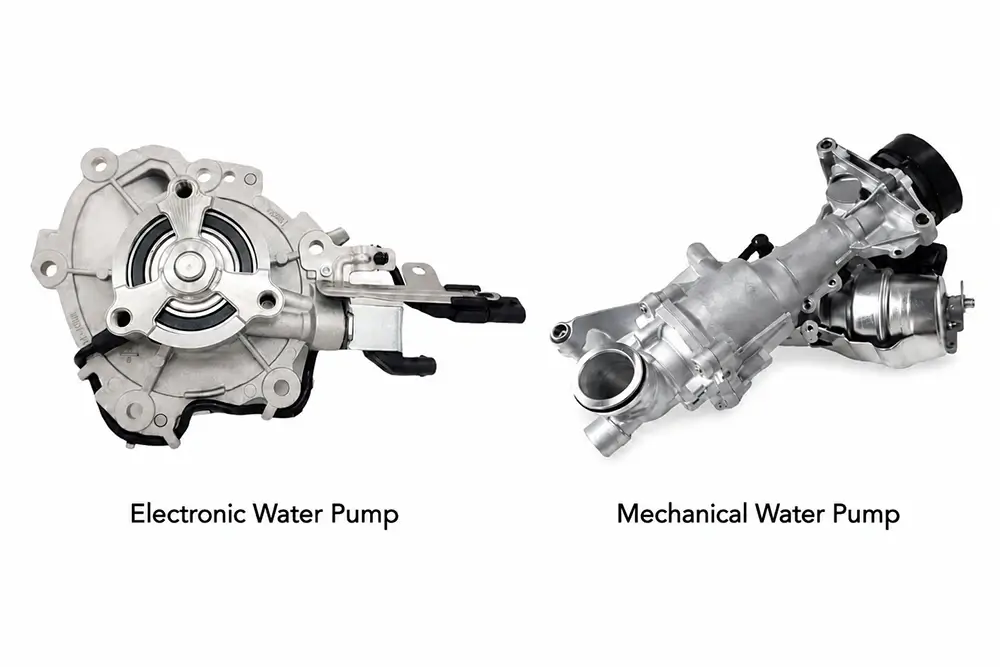
Mechanical water pumps are driven by a belt, chain, gear or another engine-driven arrangement and normally operate in relation to engine speed. Electric water pumps use an electric motor and may operate independently according to the cooling-system design and control requirements.
For replacement sourcing, the important question is not which type is better. Buyers must first determine whether the pump is the main engine coolant pump or an auxiliary circulation pump, then confirm the OE number, engine code, mounting structure, port direction and, for an electric pump, the electrical and control requirements.
A mechanical and electric water pump should not be treated as directly interchangeable unless the vehicle cooling system was specifically designed or modified for that arrangement.
Mechanical vs Electric Water Pump: Quick Comparison
| Comparison point | Mechanical water pump | Electric water pump |
|---|---|---|
| Drive source | Belt, chain, gear or engine-driven module | Electric motor |
| Relation to engine speed | Normally linked to engine operation | Can operate independently of engine speed |
| Common cooling-system role | Often the main engine coolant pump | Main pump, auxiliary pump or dedicated circuit pump |
| Control requirements | Determined mainly by the mechanical drive arrangement | May require a defined voltage, connector, pin arrangement or control signal |
| Main identification points | OE number, housing, pulley or gear, mounting face, impeller and ports | OE number, connector, pins, housing, controller, mounting and ports |
| Direct replacement compatibility | Application-specific | Application- and control-specific |
Wellgine supplies selected mechanical and electric car water pumps for B2B replacement and sourcing requirements. The correct part should be confirmed from application evidence rather than pump appearance alone.
Mechanical, Electric, Main and Auxiliary Do Not Mean the Same Thing
Mechanical and electric describe how a water pump is driven. Main and auxiliary describe the pump’s function in the cooling circuit. These terms answer different questions.
| Term | What it describes | Typical meaning |
|---|---|---|
| Mechanical pump | Drive method | Driven by a belt, chain, gear or engine-driven assembly |
| Electric pump | Drive and control method | Driven by an electric motor and controlled according to the vehicle design |
| Main pump | Cooling-circuit role | Circulates coolant through the primary engine cooling circuit |
| Auxiliary pump | Cooling-circuit role | Supports a secondary circuit or an operating condition such as heater, turbo or after-run circulation |
An electric pump is not automatically an auxiliary pump. Some vehicles use an electric pump as the main engine coolant pump. Equally, one vehicle may use a mechanical main pump together with one or more electric auxiliary pumps.
Modern vehicles may include separate coolant circuits for the engine, cabin heater, turbocharger, hybrid system, battery or power electronics. The buyer should identify the exact circuit before comparing dimensions, ports or connectors.
How a Mechanical Water Pump Works
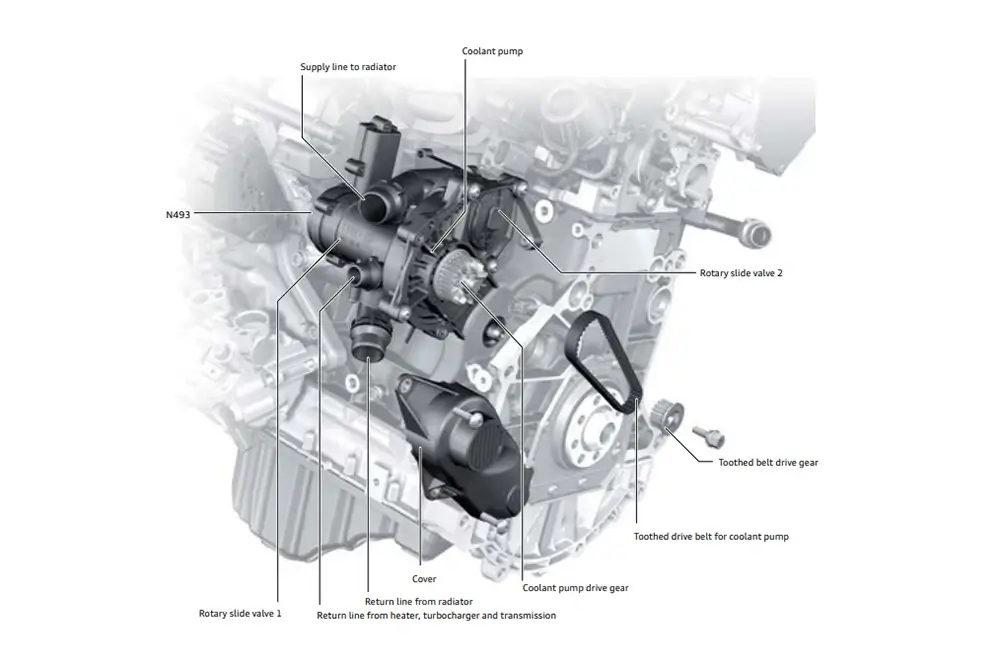
A mechanical water pump receives rotational drive from the engine. Depending on the application, the drive may come from an auxiliary belt, timing belt, timing chain, gear or integrated engine module. Pump speed therefore normally changes with engine operation.
Typical components include a housing, shaft, bearing, seal and impeller. Some pumps also include a pulley, sprocket, gear, cover or a wider housing assembly. Mechanical pumps are frequently used as the main engine coolant pump in conventional petrol and diesel applications, but their mounting face, drive structure, impeller depth, housing and port directions vary by engine.
How an Electric Water Pump Works
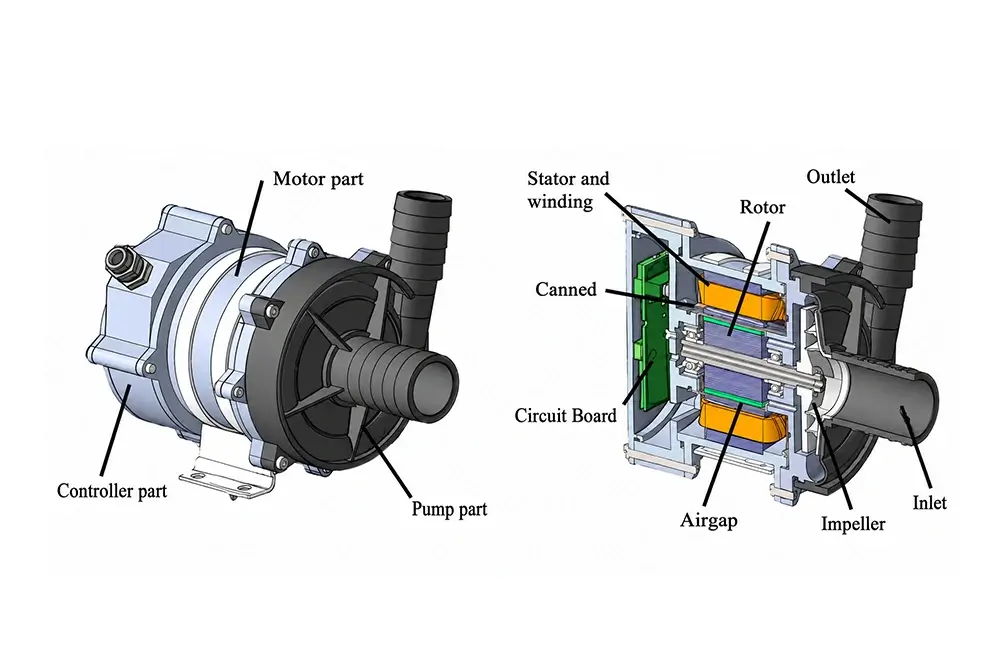
An electric water pump uses an electric motor rather than a direct engine drive. Its operation may be controlled according to coolant temperature, engine load, cabin-heating demand or another thermal-management requirement defined by the vehicle system.
An electric pump may serve as the main coolant pump, an auxiliary circulation pump or a dedicated pump for another cooling circuit. Similar-looking electric pumps can still differ in voltage, connector keying, pin arrangement, control method, mounting bracket and inlet or outlet direction.
Can a Mechanical Water Pump Replace an Electric Water Pump?
In normal OE replacement sourcing, a mechanical and electric water pump are not direct substitutes. A change between the two normally affects several parts of the cooling system.
Drive and control
A mechanical pump requires the correct physical drive, shaft position, pulley, sprocket or gear relationship. An electric pump requires the correct power supply and may also depend on a defined pin arrangement, control signal or integrated controller.
Cooling-circuit role
A main engine pump and an auxiliary heater, turbo or after-run pump are designed for different system roles. Two pumps fitted to the same vehicle should not be treated as interchangeable simply because both circulate coolant.
Flow and pressure requirements
Required coolant flow depends on the circuit, engine operating range and system resistance. Hose diameter or overall pump size does not establish equivalent performance. Any flow, pressure or control data should be checked against the applicable OE information, approved specification or validated sample.
Installation and system integration
Mechanical pumps may differ in bolt pattern, flange position, pulley offset, impeller depth and housing profile. Electric pumps may differ in connector orientation, pin configuration, brackets, controller design and port direction. These differences affect both installation and system operation.
How to Identify the Correct Replacement Water Pump
1. Confirm the cooling-circuit role
Determine whether the pump belongs to the primary engine cooling circuit or a secondary circuit. Possible roles include:
- main engine coolant circulation;
- cabin-heater circulation;
- turbocharger cooling;
- after-run cooling;
- hybrid, battery, inverter or another dedicated thermal circuit.
2. Confirm the OE number and engine code
Use the full OE or reference number together with the engine code. Vehicle model and displacement are supporting information but may be too broad when several engines or cooling layouts are used within the same model range.
3. Check the mechanical structure
For mechanical pumps, compare the pulley, gear or sprocket, mounting face, bolt pattern, locating features, housing, impeller and inlet or outlet direction. A front-view photograph alone may not reveal differences in the rear mounting face or drive arrangement.
4. Check the electrical requirements
For electric pumps, confirm the rated electrical requirement, connector shape, keying, pin count, control arrangement, mounting bracket and port direction. A matching connector shape does not prove equivalent voltage, pin assignment or control compatibility.
5. Confirm the supplied assembly scope
Clarify whether the quotation includes the pump only, pump with housing, thermostat or module, mounting components, seals or other accessories. The OE number may identify a family while the supplied scope still differs.
Mechanical or Electric? Practical Identification Checklist
| Observation point | Likely mechanical pump | Likely electric pump | Still needs confirmation |
|---|---|---|---|
| Drive feature | Pulley, belt, gear or sprocket | Electric motor | OE number and engine code |
| Electrical connector | Normally not required for the pump drive | Power or control connector present | Voltage, pin arrangement and control method |
| Operating relationship | Normally linked to engine operation | May operate independently | Cooling-circuit role |
| Common role | Often the main pump | Main or auxiliary pump | Vehicle-specific cooling design |
| Replacement evidence | Mounting, drive, housing and ports | Connector, controller, mounting and ports | OE data, application and supplied scope |
Electric Water Pump Example: LR118241 for AJ20P4
The Wellgine product range includes the LR118241 electrical water pump for selected Jaguar Land Rover AJ20P4 2.0T applications. This example shows why an electric pump should be confirmed by OE number, engine platform, connector, mounting and port layout rather than identified from the presence of an electrical connector alone.
Buyers reviewing related applications can also see the Jaguar Land Rover water pumps category. Product applicability and supplied scope should still be checked for the exact enquiry.
Water-Pump-Specific Inspection Points
Inspection and verification requirements depend on the water pump type, approved specification and order requirements. Applicable checks may include product identity, dimensions, housing, connector, rotation, sealing or functional verification.
Mechanical water pump checks
- OE reference, housing version and supplied scope;
- mounting dimensions and bolt pattern;
- shaft rotation and bearing condition where applicable;
- pulley, sprocket or gear configuration;
- impeller and seal-area condition;
- inlet and outlet orientation;
- agreed leakage or functional checks.
Electric water pump checks
- OE reference, housing and mounting structure;
- connector condition, orientation and pin configuration;
- electrical operation under the applicable specification;
- running or rotation behaviour where specified;
- port orientation and sealing surfaces;
- agreed leakage or functional-performance checks.
For batch orders, the buyer and supplier should define the applicable inspection method, sample size and acceptance criteria before production.
Common Water Pump Sourcing Errors
- Treating every electric pump as an auxiliary pump: an electric pump may also be the main coolant pump.
- Matching by hose diameter alone: port size does not confirm flow, mounting, system role or control requirements.
- Ignoring connector details: similar connectors may use different pins, electrical requirements or control arrangements.
- Confusing two pumps on the same vehicle: a main and auxiliary pump may be fitted together.
- Relying only on vehicle model: engine code, production period and market specification can change the required pump.
- Overlooking port direction: inlet and outlet orientation may prevent correct installation even when the housing looks similar.
- Ignoring supplied scope: pump-only and complete housing or module quotations may refer to different deliverables.
Information to Send for Water Pump Matching
For a replacement or wholesale enquiry, provide:
- OE or reference number;
- engine code and vehicle application;
- whether the pump is believed to be main or auxiliary;
- front, rear, mounting and port photographs;
- connector and pin details for an electric pump;
- required assembly scope;
- quantity, packaging and destination market.
The engine parts enquiry checklist explains how to prepare the wider information needed for application review and quotation.
Frequently Asked Questions
Is every electric water pump an auxiliary pump?
No. An electric pump may be the main engine coolant pump or may support an auxiliary cooling circuit. Its function must be confirmed for the specific vehicle and engine application.
Can a mechanical water pump be replaced by an electric pump?
Not as a direct OE replacement in normal sourcing practice. The drive, mounting, coolant circuit and control requirements are different.
Can two electric water pumps with the same connector be interchangeable?
Not necessarily. They may differ in voltage, pin assignment, control method, flow requirement, mounting points and port orientation.
Does every electric water pump communicate with the ECU?
No. Control arrangements vary by design. Some pumps use a relatively simple electrical supply, while others require an application-specific control method or integrated controller.
Can a water pump be identified by hose diameter alone?
No. Buyers should also confirm the OE reference, engine code, cooling-circuit role, housing, mounting points, port direction and any electrical requirements.
What is the difference between a main and auxiliary water pump?
A main pump serves the primary engine cooling circuit. An auxiliary pump supports a secondary function or separate thermal circuit. Either role may use an electric pump, depending on the vehicle design.
Request Water Pump Application Review
Wellgine supports selected water pump replacement, wholesale and sourcing enquiries for international B2B buyers. Send the OE reference, engine code, cooling-circuit role, product photographs, connector details where applicable, required scope and quantity.
Send your water pump OE number and application details to Wellgine.