AJ126 and AJ133 engines share enough Jaguar Land Rover architecture for some oil pump references to appear across both engine families. That does not mean every AJ126 and AJ133 oil pump is interchangeable.
For replacement and wholesale purchasing, the correct sequence is to identify the engine, vehicle and production range first, then verify the OE reference and physical pump configuration. This becomes particularly important when numbers such as LR098386, LR061968, AJ813913 or C2Z29995 appear in supplier catalogues.
Do not match a Jaguar Land Rover oil pump from “AJ126” or “AJ133” alone. Use the engine code together with the original OE number, VIN or production range, drivetrain layout and pump structure.
AJ126 and AJ133: Start With the Engine Boundary
The AJ126 is Jaguar Land Rover’s 3.0-litre supercharged V6 petrol engine. The AJ133 is the 5.0-litre V8 petrol family, which appears in naturally aspirated and supercharged configurations depending on vehicle and production period.
The two engine families are closely related, which explains why technicians and parts catalogues often place them together. That relationship is useful when identifying components, but it should not be treated as proof that every lubrication-system component is shared.
For oil pump purchasing, three factors matter more than engine-family similarity:
- production generation and VIN range;
- the OE-number history for the specific vehicle;
- the physical configuration of the pump and surrounding oil system.
This is why an oil pump advertised simply as “AJ126/AJ133 compatible” still needs an application check before a batch order is approved.
AJ126 Oil Pumps Changed Across Production Periods
The Jaguar parts catalogue provides a useful example of why model year matters.
For the XF 3.0-litre supercharged V6, Jaguar separates the oil-pump system into pre-15MY and from-15MY applications. The later catalogue identifies a twin-stage oil pump and includes C2Z29995 and AJ813913 within that application group.
Earlier 3.0-litre applications can instead be found with references such as C2Z28368.
This distinction immediately creates a procurement risk: two pumps may both be described online as “AJ126 oil pumps” while belonging to different production configurations.
A purchasing team should therefore record:
| Matching field | Information required |
|---|---|
| Engine | AJ126 / 306PS and relevant variant |
| Vehicle | XF, XE, F-TYPE, Range Rover, etc. |
| Production details | Model year and VIN |
| Original pump | Full OE number from the removed component or parts record |
| Drivetrain | RWD, AWD or relevant 4WD application |
| Pump configuration | Housing, ports, drive interface and control components |
The engine name identifies the family. It does not finish the part-number match.
AJ133 Has Its Own Oil Pump Revision History
The AJ133 presents the same problem from the other direction.
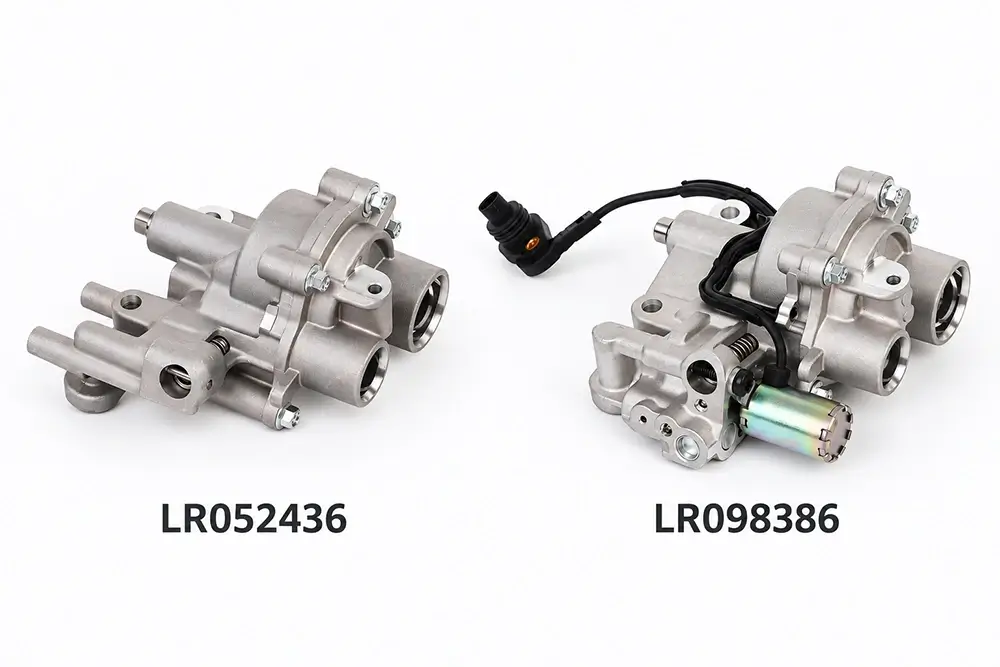
Earlier Land Rover 5.0-litre applications show several oil-pump references across VIN ranges, including the LR010703, LR035118 and LR052436 family.
This matters when a buyer is comparing an early AJ133 pump with a later LR098386-style unit.
A similar aluminium housing or a shared 5.0-litre engine description is not sufficient evidence for replacement. Different production stages can involve changes to the pump assembly, oil-delivery components or control arrangement.
Before replacing an earlier AJ133 reference with another number, confirm the supersession against the specific vehicle and VIN rather than relying on an aftermarket cross-reference list alone.
Where Does LR098386 Fit?
LR098386 is relevant to selected later Jaguar Land Rover petrol applications and is commonly associated with both AJ126 3.0-litre V6 and AJ133 5.0-litre V8 engines.
For the current Wellgine LR098386 oil pump, related references include:
- LR098386
- LR061968
- AJ813913
- C2Z29995
These numbers are useful starting points for identification, but they should not be read as a statement that every vehicle using any one of these numbers accepts every other number without further checks.
Later parts catalogues commonly show LR061968 being replaced by LR098386, and current parts databases list LR098386 across selected 3.0-litre and 5.0-litre petrol applications. The final decision should still be made from the vehicle-specific parts record or VIN.
This distinction is particularly important for distributors. A cross-reference database may be broad enough for product discovery but not precise enough for approving hundreds of units for stock.
What if the Original Pump Is LR052436 or C2Z28368?
Do not move directly to LR098386 simply because the vehicle has an AJ126 or AJ133 engine.
Instead:
- identify the original OE number;
- locate the vehicle-specific OE history;
- confirm the VIN break;
- compare the pump physically;
- verify any surrounding oil pickup, sump or drive differences.
If those checks do not establish the replacement relationship, treat the application as unresolved.
RWD, AWD and 4WD Can Affect the Oil-System Package
Drivetrain information should be part of an oil-pump enquiry.
Jaguar parts documentation for the 3.0-litre supercharged engine distinguishes oil pickup arrangements between AWD and RWD applications. That is an important warning for procurement teams: the same engine family does not necessarily mean that every surrounding lubrication component is identical.
Even where the main pump is shared, differences may exist in:
- oil pickup pipes;
- sump configuration;
- pipe routing;
- installation clearance;
- related seals and fittings.
For this reason, the RFQ should state RWD, AWD or 4WD rather than supplying only the engine code.
How to Compare Two AJ126 or AJ133 Oil Pumps From Photos
OE information comes first, but photographs are valuable for detecting obvious mismatches before samples are shipped. For a broader explanation of these features, see our engine oil pump structure guide.
| Photo/check | What to compare |
|---|---|
| Front housing | Overall casting shape and mounting outline |
| Rear mounting face | Bolt positions, sealing surfaces and oil passages |
| Side profile | Housing depth, offsets and protrusions |
| Drive interface | Sprocket, shaft and drive arrangement |
| Oil inlet | Position, diameter and connection geometry |
| Oil outlet | Port location and orientation |
| Electrical connection | Connector presence, position, orientation and pin configuration |
| Control components | Solenoid or valve arrangement where fitted |
| Casting marks | Casting numbers, revisions and manufacturer markings |
| Original label | Complete OE reference and production markings |
Do not photograph only the front of the pump.
For an effective remote match, provide at least:
- one straight front view;
- one straight rear view;
- both side views;
- a close-up of the drive area;
- a close-up of any electrical connector;
- a readable photograph of the OE or casting number.
Adding a ruler or scale beside the part can also help when two housings look similar but differ in offsets or mounting dimensions.
Do Not Confuse Pump Matching With Supplied Assembly Scope
Another common purchasing error is confirming the pump itself but not confirming what is actually included in the quotation.
Depending on the product and supplier, photographs may show components that are not part of the standard supply.
Confirm whether the quoted item includes:
- oil pump assembly;
- control valve or solenoid where applicable;
- sprocket or drive components;
- seals or O-rings;
- pickup components;
- bolts or other installation hardware.
A valid OE match does not automatically mean the supplied assemblies are commercially equivalent.
For distributors, this should be agreed before the sample or purchase order is approved.
AJ126 vs AJ133 Oil Pump Matching Workflow
1. Record the Original OE Number
Use the number on the removed pump where possible. Do not rely only on a marketplace listing or vehicle description.
2. Confirm the Engine
Record AJ126 or AJ133 together with the complete engine code where available.
3. Confirm the Vehicle and VIN
Include the make, model, model year and VIN or production range. VIN splits are particularly important where Jaguar Land Rover changed pumps during a model’s production.
4. Record the Drivetrain
Specify RWD, AWD or 4WD. This helps identify possible sump and oil-pickup differences.
5. Check the OE History
Determine whether the new number is the same reference, a documented replacement, a related reference requiring additional verification, or a different pump family.
Do not convert a list of related OE numbers into a universal supersession chain. Our oil pump OE-number matching guide explains the wider confirmation process.
6. Compare the Physical Pump
Check mounting points, ports, drive arrangement, electrical features and housing dimensions.
7. Confirm the Supplied Components
Make sure the quotation and sample contain the components required by the customer.
8. Approve the Application Before the Batch
For wholesale stock, resolve uncertain applications during the sample stage rather than after the production order.
Common AJ126/AJ133 Oil Pump Matching Errors
The most frequent mistakes come from using one piece of information as if it were sufficient on its own.
Matching from engine family only. “Fits AJ126 and AJ133” is too broad for final approval.
Assuming similar housings are interchangeable. Small differences in ports, mounting faces or control components can change the application.
Treating every related OE number as a supersession. A cross-reference list needs vehicle-specific confirmation.
Ignoring VIN breaks. Jaguar Land Rover revised oil-pump applications during production.
Ignoring drivetrain. RWD and AWD vehicles can use different surrounding oil-system components.
Comparing only the pump but not the assembly scope. A visually correct pump can still arrive without the required control component, seal or accessory.
Information to Send for an AJ126 or AJ133 Oil Pump Enquiry
For faster application checking, send:
- original OE number;
- engine code;
- vehicle model and production year;
- VIN or relevant production details;
- RWD/AWD/4WD configuration;
- clear front, rear and side photographs of the original pump;
- connector and drive-interface photographs;
- required quantity;
- destination country.
For an LR098386 enquiry, these details allow the OE reference and physical pump to be checked together instead of relying on the engine name alone.
For distributors, wholesalers and engine rebuilders, this approach also reduces the risk of carrying stock that fits only a narrower VIN range than originally expected.
Browse the Land Rover oil pumps range or review our engine parts quality-control process before sending an RFQ.