An OE number is the starting point for sourcing an engine oil pump, but it is not sufficient on its own. A reliable match should also confirm the engine code, vehicle application, pump structure, drive arrangement and the exact assembly scope included in the quotation.
For importers, distributors and engine-parts purchasing teams, the safest sequence is:
OE number → engine code → vehicle, year and market → pump structure → supplied assembly scope → final approval.
If any part of this evidence conflicts, the order should be paused until the supplier and buyer have resolved the difference with photographs, markings, dimensions, drawings or a physical sample.
Quick Answer: What Confirms the Correct Engine Oil Pump?
Five information groups should be checked before an engine oil pump is approved:
- OE or reference number: identifies the likely pump family and related cross-references.
- Engine code: distinguishes engine platforms and generations that may share a vehicle model or displacement.
- Vehicle model, production year and market: helps identify regional, production and application differences.
- Pump structure and drive type: confirms visible differences in the housing, mounting face, oil ports and drive arrangement.
- Supplied assembly scope: establishes whether the quotation covers the pump body, pump with housing or a wider integrated module.
No single field should override a clear conflict in the remaining evidence.
What Each Identification Detail Can—and Cannot—Confirm
| Identification detail | What it can help confirm | What it cannot confirm alone | What the buyer should provide |
|---|---|---|---|
| OE number | Initial cross-reference and likely product family | Engine revision, structural change, market variation or supplied scope | Complete OE number and a clear photograph of the original marking |
| Engine code | Engine platform and generation | Exact pump revision, housing or assembly scope | Full engine code, displacement and fuel type where available |
| Vehicle application | Vehicle and production context | Which engine or pump revision is fitted to every vehicle with the same model name | Brand, model, production year and destination market |
| Product photographs | Housing, mounting face, drive and oil-port differences | Internal pressure specification or unverified interchangeability | Front, rear, side, drive-area and oil-port photographs |
| Sample or drawing | Dimensions, structure and assembly comparison | Performance, service life or application without separate validation | Labelled sample, drawing and project requirements |
Step-by-Step Oil Pump Matching Workflow
Step 1 — Normalise the OE Reference
Record the complete number exactly as it appears on the original pump, packaging or verified catalogue record. Remove accidental spaces or formatting differences, but do not alter the number itself. Buyers should distinguish among:
- the original OE number;
- a superseding number;
- an aftermarket reference;
- and a related number that is not necessarily interchangeable.
Similar-looking part numbers should never be treated as proof of interchangeability. Where a superseding number is involved, confirm the engine platform, pump structure and applicable supply scope before approval.
Step 2 — Confirm the Engine Code
The same vehicle model may use different engines across production periods and markets. A displacement such as “2.0 litre” is usually too broad because several engine generations may share that capacity while using different oil pump designs.
Use the full engine code together with the OE number. The engine code should support the proposed match, not merely appear in a broad application list.
Step 3 — Confirm Vehicle, Year and Market
Provide the vehicle brand, model, production year and market. Petrol and diesel versions, regional specifications and production changes may affect the installed pump.
Vehicle information is supporting evidence. It should not replace the OE number or engine code where those details are available.
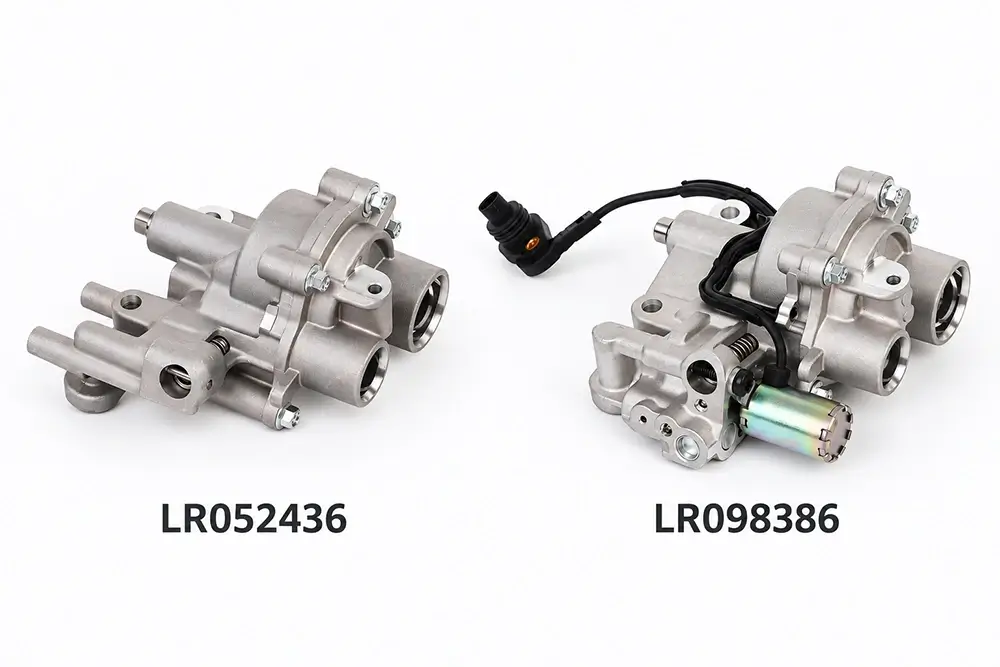
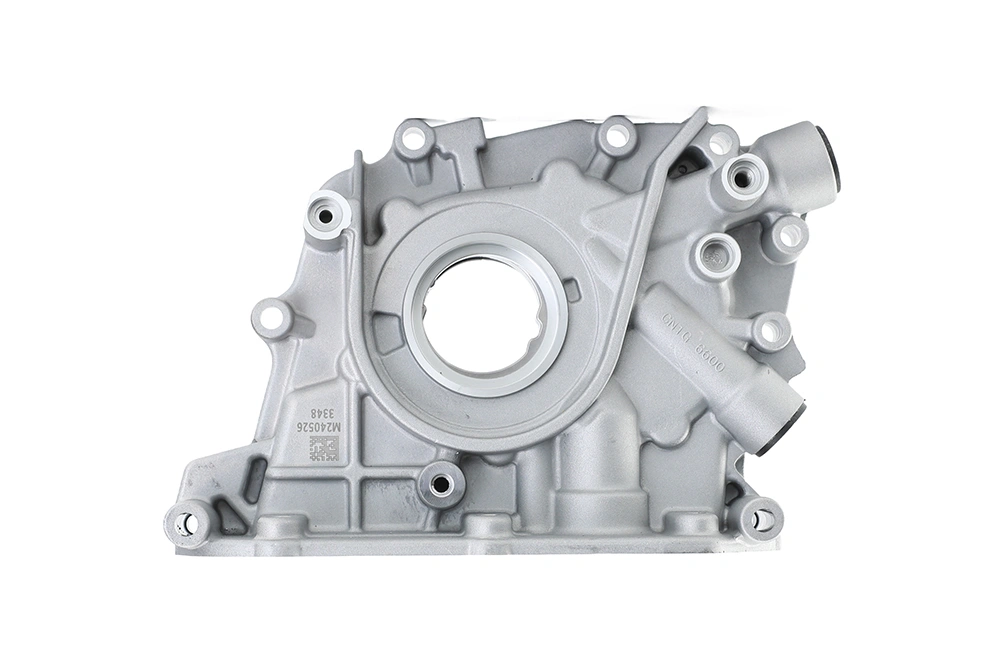
Step 4 — Compare the Pump Structure
At procurement stage, compare the following visible features:
- drive type and drive position;
- housing shape and casting details;
- front and rear mounting faces;
- oil inlet and outlet positions;
- bolt pattern and locating features;
- pump body only versus pump with housing or module.
A front photograph alone is not enough. The rear mounting face and drive area often reveal differences that are not visible from the front. For a detailed structural explanation, use the engine oil pump structure guide.
Step 5 — Confirm the Quoted Supply Scope
Before approving the quotation, confirm exactly what is included. Depending on the application, the requested product may be:
- the pump body only;
- the pump with its housing;
- a pump integrated with a vacuum-pump unit;
- a balance-shaft or lubrication module;
- a pump supplied with a control solenoid;
- or an assembly that includes a pickup or other accessories.
A correct OE reference can still lead to a commercial dispute if the quoted assembly scope is different from the buyer’s requirement.
What to Do When the OE Number and Engine Information Conflict
Conflicting evidence should trigger further verification rather than automatic approval. Common examples include:
- The OE number matches, but the engine code does not: check whether the number is a broad cross-reference or belongs to a different engine generation.
- The vehicle matches, but the pump structure is different: compare the production year, market and rear mounting face.
- An old number and a superseding number are both listed: confirm the replacement chain and the applicable engine or production range.
- The front view looks identical, but the rear face differs: do not approve the part until the mounting, drive and oil-port arrangement has been compared.
- The buyer requires a complete assembly, but the quotation covers the pump body: revise the quotation and state the supplied scope explicitly.
- The sample conflicts with the catalogue information: label the sample, record the differences and request technical review before batch approval.
Procurement rule: when the evidence conflicts, do not approve the order on the basis of one matching field.
Matching Evidence and RFQ Requirements
| Required information | Recommended format | Why it matters |
|---|---|---|
| OE or reference number | Complete number plus a photograph of the original marking | Provides the starting cross-reference |
| Engine code | Full code rather than displacement alone | Separates engine generations and versions |
| Vehicle | Brand, model, production year and market | Supports application checking |
| Product photographs | Front, rear, side, drive and oil-port views | Reveals structural differences |
| Required scope | Pump only, pump with housing or complete assembly | Prevents quotation and delivery misunderstandings |
| Quantity | Sample quantity and expected batch requirement | Supports quotation and production planning |
| Packaging | Neutral or confirmed private-label requirement | Defines commercial preparation |
| Destination market | Country or sales region | Helps identify application and documentation requirements |
Buyers preparing a wider engine-parts request can also use the engine parts enquiry checklist to organise the information required for quotation.
How to Prepare Product Photographs
Photographs should show the complete part rather than a cropped detail. Where possible, provide:
- a close-up of the OE and casting marks;
- the complete front face;
- the rear mounting face;
- the drive side;
- all visible oil inlets and outlets;
- the complete housing or attached module;
- and a scale reference where dimensions are relevant.
If the pump forms part of a wider module, photograph the full assembly before removing attached components. This helps the supplier understand whether the enquiry concerns the pump, the housing or the complete unit.
When a Physical Sample or Drawing Is Necessary
A physical sample or drawing may be required when:
- the OE number cannot be read;
- two references conflict;
- the housing or mounting face differs from the proposed product;
- the required assembly scope is unclear;
- or the buyer is developing a repeat or private-label programme that requires dimensional confirmation.
The sample should be labelled with the available OE reference, engine code, vehicle application and project requirement. Sample review can support structural and dimensional comparison, but it should not be presented as proof of performance or fitment unless those points have been separately verified.
Wellgine Product Examples for Applying the Matching Workflow
The examples below show how OE number and engine-platform information can be combined. They are based on current Wellgine product records and should still be checked against the buyer’s exact application and required assembly scope.
06H115105AP — VW Audi EA888 Gen2
The Wellgine product record identifies oil pump 06H115105AP for the VW Audi EA888 Gen2 1.8T and 2.0T engine platform. A buyer should confirm the OE reference, engine generation and the front and rear pump structure rather than relying only on a VW or Audi model name.
Related category: VW oil pumps.
LR013487 — Land Rover TDV6
The Wellgine product record identifies LR013487 oil pump for the TDV6 2.7L and 3.0L diesel engine platform. The matching review should confirm the original reference, engine information and the complete front-cover or pump assembly scope requested by the buyer.
Related category: Land Rover oil pumps.
11417624135 — BMW B46/B48
The Wellgine product record identifies oil pump 11417624135 for the BMW B46/B48 engine platform. The buyer should confirm the full engine code, application and supplied scope before treating a broad BMW chassis reference as final proof of fitment.
Related category: BMW oil pumps.
Related Oil Pump Guides and Page Roles
Each Wellgine oil pump page should answer a different question:
- This sourcing guide: how to confirm an oil pump using the OE number, engine code, vehicle application and RFQ evidence.
- Engine Oil Pump Structure Guide: how housings, drives, oil passages and assembly scope differ.
- Bad Engine Oil Pump Symptoms: symptom and diagnosis context before replacement sourcing.
- Engine Oil Pumps category: current product range and the commercial enquiry path.
This separation prevents one page from trying to cover sourcing, structure, fault diagnosis and the complete product catalogue at the same time.
Questions to Confirm Before Ordering
- Which OE reference and engine code support the proposed match?
- Does the quoted pump match the required vehicle, year and market?
- What exact assembly scope is included?
- Have the mounting face, drive, oil ports and housing been compared?
- Are more photographs, dimensions or a sample required?
- What inspection, packaging and quantity requirements apply to the order?
Frequently Asked Questions
Is an OE number enough to confirm an engine oil pump?
Not always. The OE number should be checked against the engine code, vehicle application, pump structure and supplied assembly scope.
What should I do if the OE number matches but the pump housing is different?
Do not approve the product on the OE number alone. Compare the mounting face, drive, oil ports, housing and complete assembly, then request further evidence if the difference cannot be explained.
Can a superseding OE number confirm interchangeability by itself?
No. A superseding number should be supported by application and structural confirmation. The relevant engine generation, production period and market may also need to be checked.
What should an importer send for quotation?
Send the OE number, engine code, vehicle application, clear product photographs, required supply scope, quantity, packaging requirement and destination market.
Request an Oil Pump Matching Review
Wellgine supplies selected aftermarket engine oil pumps for international B2B buyers. For a matching review, provide:
- OE reference;
- engine code;
- vehicle and market information;
- front and rear product photographs;
- required assembly scope;
- quantity;
- packaging requirement;
- and destination market.