A VVT solenoid and a camshaft position sensor are not the same component. A VVT solenoid is an electrically controlled oil valve that helps the engine control system change camshaft timing. A camshaft position sensor measures camshaft position and sends that information back to the engine control unit.
In simple terms, the solenoid acts; the sensor reports.
They may be installed near the same cylinder head or camshaft area, and faults in either can be associated with timing-related engine problems. That is why the names are sometimes confused in parts enquiries, diagnostic discussions and aftermarket catalogues.
For parts buyers, however, they must be identified separately. Their function, internal construction, electrical interface and replacement reference are different.
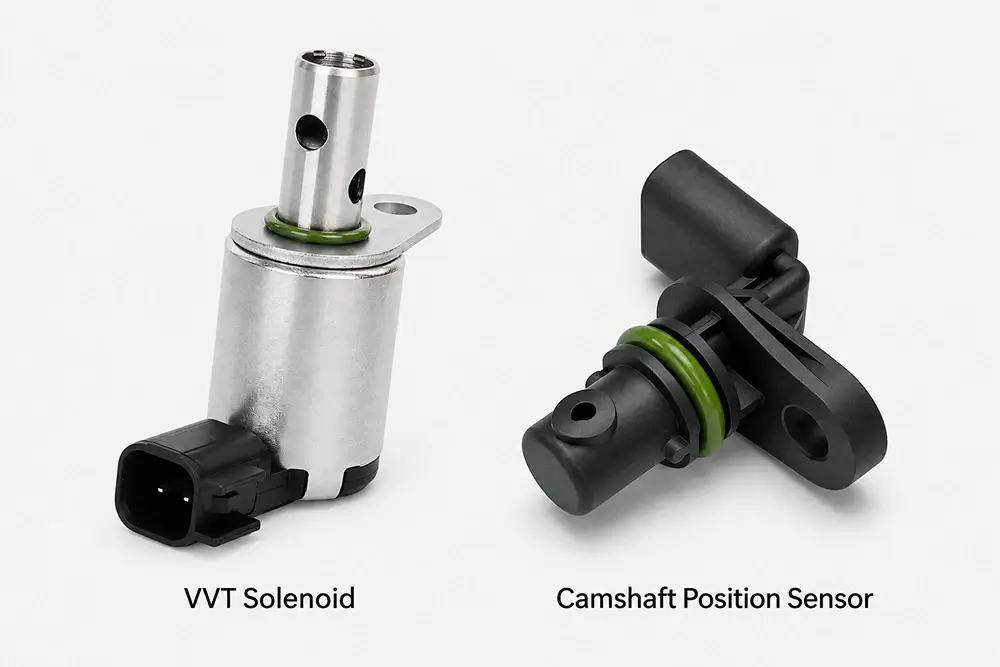
VVT Solenoid vs Camshaft Position Sensor: Quick Comparison
| Comparison | VVT Solenoid / Oil Control Valve | Camshaft Position Sensor |
|---|---|---|
| Main role | Controls engine-oil flow used for variable camshaft timing | Detects camshaft position |
| Component type | Electrically controlled hydraulic valve / actuator | Electronic position sensor |
| Direction of information | Receives a command from the ECU | Sends a position signal to the ECU |
| Effect on cam timing | Helps control the hydraulic circuit that changes timing | Monitors the resulting camshaft position |
| Typical mounting area | Cylinder head, timing cover or oil-control passage, depending on engine | Cylinder head near the camshaft or trigger/reluctor wheel |
| Main identification points | OE reference, connector, pin configuration, valve body, oil ports and mounting position | OE reference, connector, sensor body, mounting point and engine position |
| Same part? | No | No |
The exact construction and location vary by engine. Vehicle-specific service information should therefore be used before identifying or replacing either component.
What Does a VVT Solenoid Do?
A VVT solenoid is commonly used in a hydraulically controlled variable valve timing system.
Depending on the vehicle manufacturer or catalogue, it may also be described as a:
- VVT solenoid;
- oil control valve or OCV;
- camshaft timing oil control valve;
- camshaft actuator solenoid;
- cam timing control solenoid;
- VCT solenoid in some applications.
These names can describe a similar oil-control function, but they do not prove that individual parts are interchangeable.
The engine control unit sends an electrical command to the solenoid. Inside the valve, an electromagnetic mechanism changes the position of a spool or valve element. This redirects pressurised engine oil through the timing-control circuit.
The controlled oil pressure then allows the variable timing mechanism to advance, retard or maintain the required camshaft timing position.
The important distinction is that the VVT solenoid does not measure the camshaft position. Its job is to control the hydraulic side of the timing system.
For the wider ECU–oil-control–camshaft operating sequence, see the VVT System Guide.
What Does a Camshaft Position Sensor Do?
A camshaft position sensor is a monitoring component.
It detects the rotational position of the camshaft and sends an electrical signal to the engine control unit. Together with information from the crankshaft position sensor and other engine inputs, this allows the control system to determine engine position and manage functions such as injection, ignition and camshaft timing feedback.
On many systems, this feedback is also important for VVT control.
The ECU may command a timing change through the VVT solenoid and then use camshaft-position information to determine whether the actual camshaft movement corresponds with the requested position.
This gives the two components fundamentally different roles:
VVT solenoid: receives a control command.
Camshaft position sensor: provides position feedback.
How the Solenoid and Sensor Work Together
The relationship is easier to understand as a control loop:
- The ECU calculates a required camshaft timing position from engine operating data.
- It sends a control signal to the VVT solenoid or oil control valve.
- The solenoid regulates oil flow through the VVT hydraulic circuit.
- The camshaft timing mechanism changes the camshaft’s angular position.
- The camshaft position sensor monitors the resulting position.
- The ECU compares the actual position with the required position and adjusts the control command where necessary.
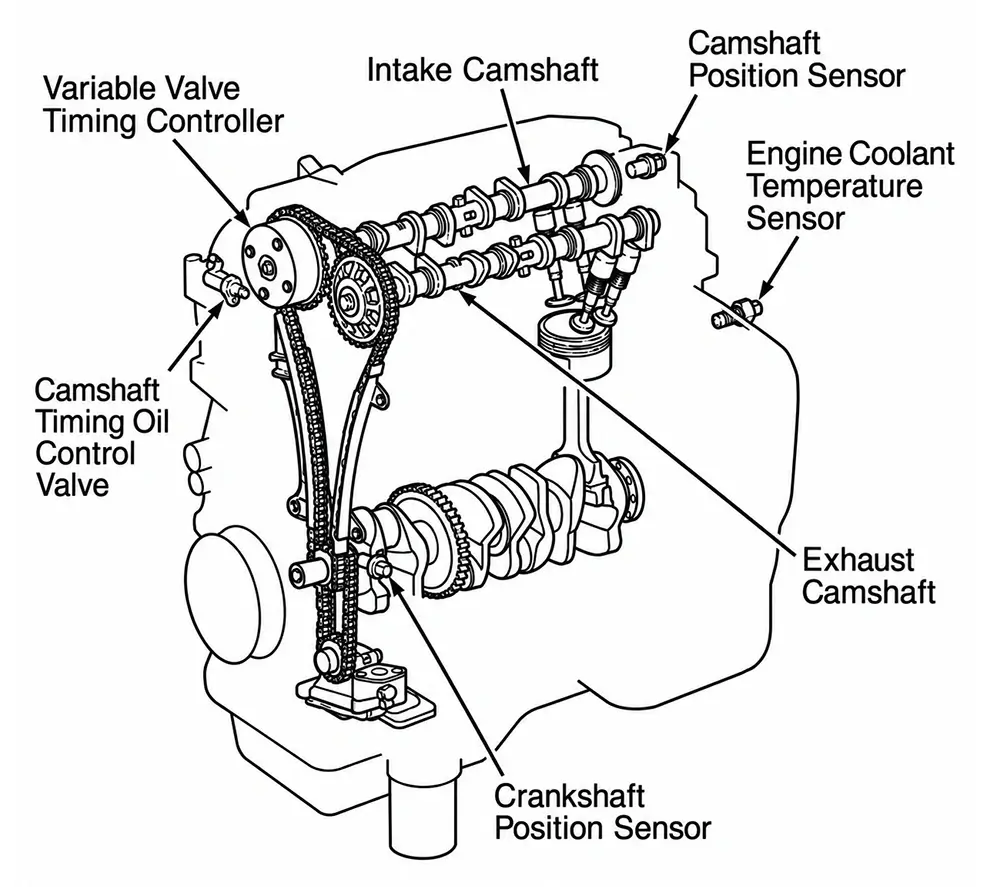
This is why one timing-related fault does not automatically identify one failed component.
A problem may exist in the command, electrical circuit, hydraulic oil circuit, mechanical timing mechanism or feedback signal.
Why Are VVT Solenoids and Camshaft Sensors Confused?
They Can Be Located Close Together
Both components may be installed around the cylinder head and camshaft area. On some engines, several similar electrical connectors appear within a small space.
Location alone is therefore not enough for identification.
The Terminology Is Inconsistent
“Camshaft solenoid”, “camshaft actuator solenoid”, “VVT solenoid” and “oil control valve” may describe the timing-control valve in different catalogues.
At the same time, some technical literature uses expressions such as “VVT sensor” for a camshaft-position-related sensor.
A product name therefore cannot replace an OE-reference and application check.
Their Faults Can Affect the Same Timing-Control System
A VVT control problem may involve:
- the solenoid;
- the solenoid circuit;
- engine oil condition or pressure;
- an oil passage;
- mechanical timing components;
- a camshaft position sensor;
- a crankshaft position sensor;
- wiring or connectors.
The same warning lamp or timing-related diagnostic complaint can therefore lead buyers to the wrong component if the part is selected from the symptom alone.
Typical VVT Solenoid Symptoms
A VVT solenoid or its control circuit may be associated with symptoms such as:
- check-engine warning;
- rough or unstable idle;
- reduced engine response;
- timing-control faults;
- poor acceleration;
- abnormal VVT operation.
However, these symptoms do not confirm that the solenoid itself has failed.
Before a replacement is selected, the diagnostic process may also need to consider oil level and condition, specified oil viscosity, oil pressure, wiring, connector condition, oil passages and other timing-system components.
Codes associated with a camshaft actuator circuit or cam timing performance should also be interpreted according to the vehicle manufacturer’s diagnostic procedure rather than used as a direct parts-order instruction.
Typical Camshaft Position Sensor Symptoms
A camshaft position sensor fault may be associated with:
- difficulty starting;
- check-engine warning;
- stored sensor or signal fault codes;
- unstable operation or engine-management fallback behaviour;
- loss or interruption of the camshaft-position signal.
Again, the symptom alone is not enough.
The wiring, connector, sensor supply, signal circuit and mechanical trigger or reluctor arrangement may also need to be checked.
For B2B sourcing, a diagnostic description such as “camshaft timing fault” should therefore not be treated as confirmation that the customer requires a camshaft position sensor.
Can Both Components Cause Similar Symptoms?
Yes.
Both belong to the wider engine-management and camshaft-timing environment, so their faults may overlap at the symptom level.
For example, a timing-related warning or unstable engine operation could involve the VVT control side, the camshaft-position feedback side or another part of the timing system.
The useful distinction is not simply the symptom. It is which part of the control chain has failed.
| Diagnostic area | VVT solenoid | Camshaft position sensor |
|---|---|---|
| ECU command circuit | Relevant | Normally not the primary function |
| Oil-flow control | Relevant | No |
| Hydraulic timing response | Relevant | Monitors result indirectly |
| Camshaft position measurement | No | Relevant |
| Position-feedback signal | No | Relevant |
| Oil contamination or restricted oil passage | Can affect operation | Does not make the sensor an oil-control component |
| Sensor signal or supply fault | Not a cam-position measurement fault | Relevant |
Oil Control Valve vs Cam Sensor
An oil control valve used for variable camshaft timing is generally a VVT solenoid-type control component.
A cam sensor, in this context, usually means the camshaft position sensor.
Their functions are therefore different:
- Oil control valve: controls oil routing or pressure in the variable timing circuit.
- Cam sensor: detects camshaft position and provides an electrical feedback signal.
This distinction is particularly important when a parts enquiry uses only terms such as “VVT sensor”, “camshaft valve”, “cam solenoid” or “timing sensor”.
The market name should be treated as a starting point, not as confirmed product identity.
How to Identify a VVT Solenoid
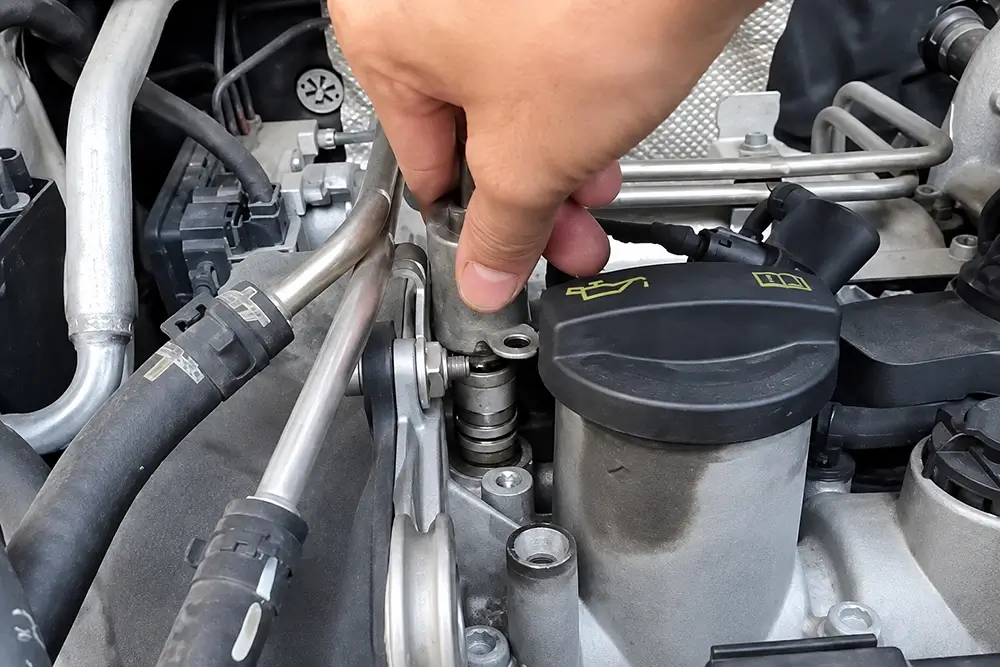
For a VVT solenoid enquiry, check:
- complete OE or reference number;
- engine code;
- vehicle application;
- intake or exhaust position, where applicable;
- cylinder bank, where applicable;
- connector shape;
- terminal or pin configuration;
- valve-body shape and length;
- oil-port or screen structure;
- retaining or mounting arrangement;
- original-part photographs.
A VVT solenoid commonly has a valve body designed to enter an oil passage, but appearance varies significantly by engine design.
For a more detailed process, see How to Identify the Correct VVT Solenoid Valve.
How to Identify a Camshaft Position Sensor
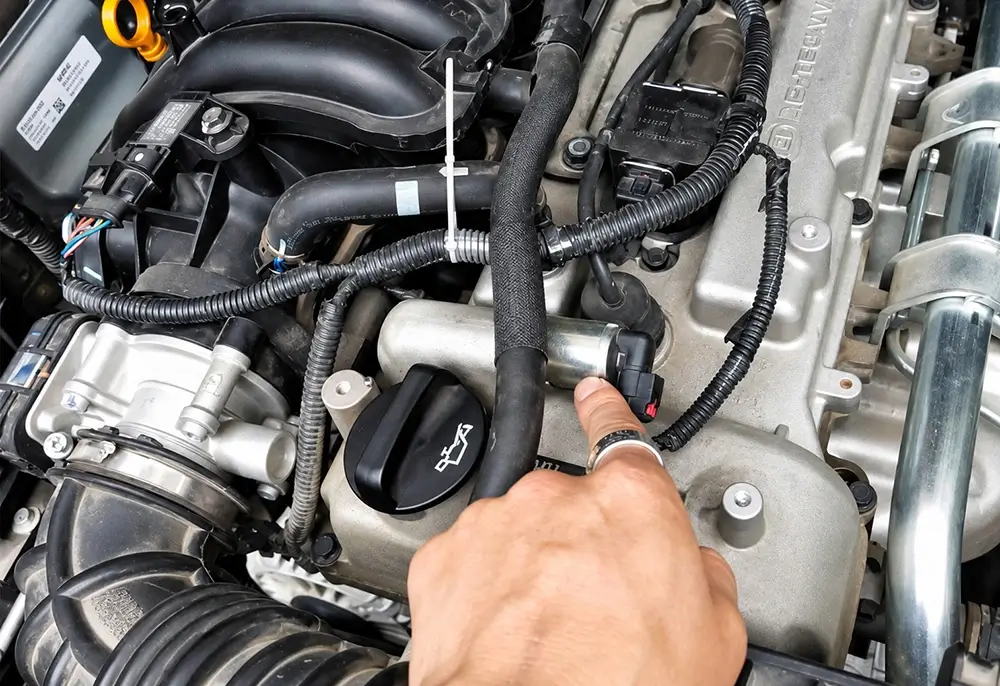
For a camshaft position sensor, check:
- complete OE or reference number;
- engine code;
- vehicle make, model, year and market;
- intake or exhaust identification where the engine uses multiple sensors;
- cylinder bank where applicable;
- connector shape and terminal count;
- sensor body and mounting flange;
- mounting-hole arrangement;
- sensor tip or sensing-end design;
- original-part markings and photographs.
Do not identify the sensor simply because it is mounted near the camshaft.
The correct part should be confirmed against the engine application and service information.
Visual Identification: Solenoid or Sensor?
A practical first check is to ask what the component is designed to interact with.
A VVT Solenoid Normally Has
- an electrical connector;
- a valve or spool-type body;
- sealing surfaces or O-rings;
- oil-control openings or passages;
- a structure designed to fit into the engine’s oil-control circuit.
A Camshaft Position Sensor Normally Has
- an electrical connector;
- a sensor body;
- a sensing end positioned towards a camshaft trigger or reluctor;
- a mounting flange or retaining point;
- no function of directing pressurised engine oil to the timing mechanism.
These characteristics help with initial identification, but OE reference and engine application should remain the final matching basis.
Do Not Diagnose Either Part from the Fault Code Alone
This is one of the most important boundaries for both repair diagnosis and replacement-parts sourcing.
A fault code describes a detected electrical, timing, performance or correlation condition. It does not always identify the component that must be replaced.
For example, a timing correlation problem may involve:
- actual mechanical timing;
- the VVT solenoid or its wiring;
- oil pressure or oil passages;
- the camshaft timing mechanism;
- the camshaft position sensor;
- the crankshaft position sensor;
- related wiring or connectors.
Likewise, an actuator-circuit fault and a position-sensor-circuit fault represent different diagnostic areas even when both descriptions contain the word “camshaft”.
Professional diagnosis should establish the cause before a replacement part is ordered.
VVT Solenoid vs Camshaft Phaser Is a Different Comparison
A camshaft position sensor should also not be confused with the camshaft phaser.
The solenoid controls the hydraulic circuit, the timing mechanism changes the camshaft position, and the sensor reports the resulting position back to the ECU.
For the separate actuator comparison, see VVT Solenoid Valve vs Camshaft Phaser.
Keeping these component roles separate prevents the terms solenoid, sensor, phaser, actuator and oil control valve from being treated as interchangeable names.
B2B Parts Matching: What Information Should Buyers Send?
For an uncertain VVT or camshaft-sensor enquiry, send:
- complete OE or reference number;
- engine code;
- vehicle make and model;
- model year and destination market;
- intake or exhaust position, if known;
- cylinder bank, if applicable;
- connector photograph;
- full product photograph;
- mounting-side or sensing/valve-body photograph;
- original markings;
- required quantity.
If the customer only supplies a diagnostic code or a product name such as “VVT sensor”, request additional identification information before confirming the replacement part.
Wellgine’s current commercial range includes selected engine solenoid valves for aftermarket and B2B supply. Product availability and application should be confirmed by OE reference, engine information and the supplied product evidence.
Frequently Asked Questions
Is a VVT Solenoid the Same as a Camshaft Position Sensor?
No. A VVT solenoid controls oil flow in the variable timing system, while a camshaft position sensor measures camshaft position and sends a signal to the ECU.
Is a VVT Solenoid a Sensor?
No. It is an electrically controlled valve or actuator in the VVT oil-control circuit. A camshaft position sensor performs the measurement and feedback function.
Is a Camshaft Solenoid the Same as a Camshaft Sensor?
Usually not. “Camshaft solenoid” may refer to a VVT or camshaft timing control solenoid, whereas “camshaft sensor” normally refers to the camshaft position sensor. Always confirm the manufacturer’s terminology and OE reference.
Is an Oil Control Valve the Same as a Camshaft Position Sensor?
No. In a hydraulic VVT system, the oil control valve regulates oil flow used for timing adjustment. The camshaft position sensor monitors camshaft position.
Can a Bad VVT Solenoid Look Like a Bad Camshaft Sensor?
The symptoms can overlap, but the causes and diagnostic tests are different. Oil condition, wiring, hydraulic response, sensor signals and mechanical timing may all need to be checked before identifying the failed component.
Where Are the VVT Solenoid and Camshaft Sensor Located?
Both may be installed around the cylinder head or camshaft area, but exact positions vary by engine. The VVT solenoid is normally connected to the timing oil circuit, while the camshaft position sensor is positioned so that it can detect camshaft rotation or position.
Request VVT Solenoid Matching
Need to confirm whether an enquiry refers to a VVT solenoid, oil control valve or another engine solenoid?
Send Wellgine the OE reference, engine code, vehicle application, connector photographs, product photographs and required quantity for component review before quotation.