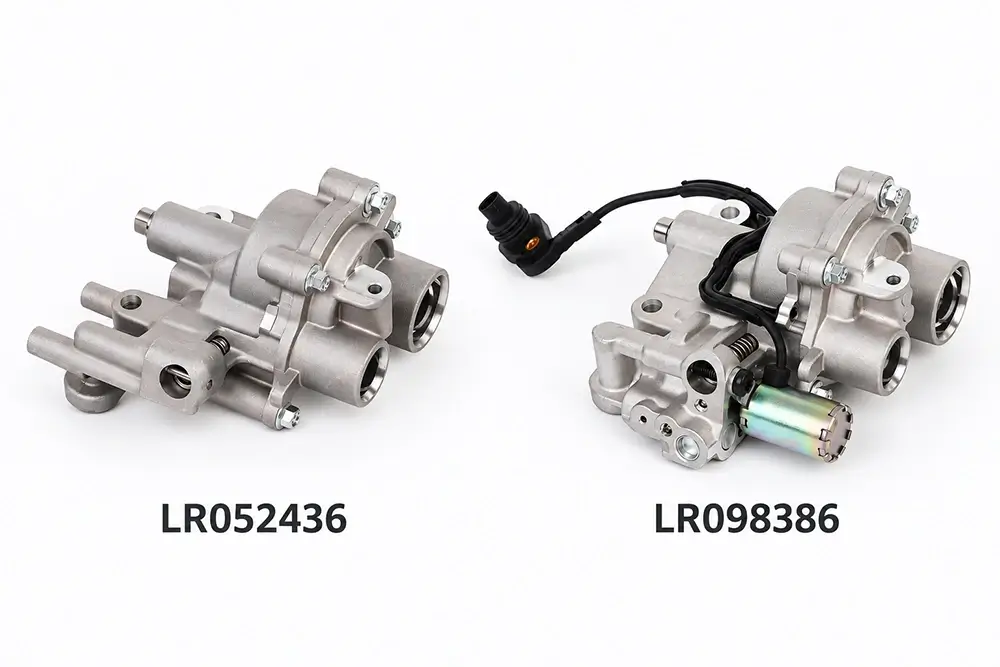
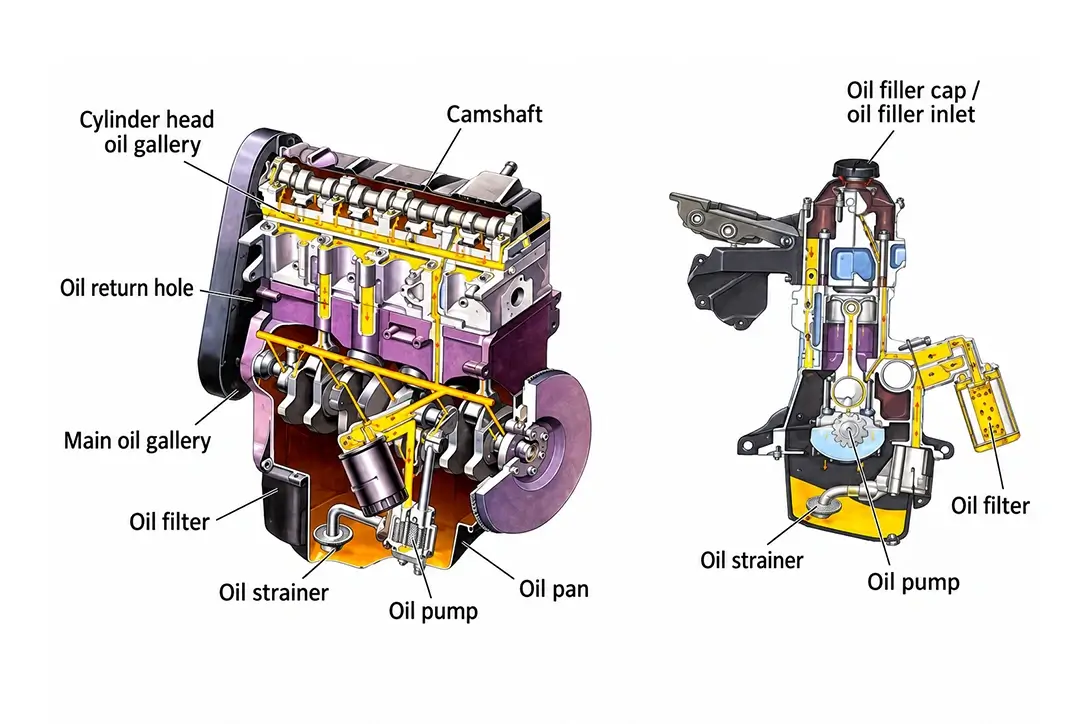
BMW N20 and B48 engines both use pressure-controlled lubrication systems, but that does not mean their oil pumps can be identified or sourced in the same way.
For parts buyers, the biggest difference is not simply the appearance of the pump housing. The pump has to be understood together with its drive arrangement, balance-shaft relationship, engine generation and OE reference.
On the N20, the oil pump is closely related to the counterbalance-shaft assembly and its chain-and-gear drive.
On the B48 family, the lubrication architecture was reorganised as part of BMW’s newer modular engine generation, and the relationship between the oil pump, drive chain, vacuum-pump function and counterbalance shafts differs from the N20 design.
That makes one rule especially important:
An N20 oil pump should not be cross-matched to a B48 oil pump by engine displacement, vehicle model or visual similarity alone.
N20 and B48 Oil Pumps at a Glance
The easiest way to compare the two engines is to separate three questions:
How is the pump driven?
How does it relate to the balance-shaft system?
What information is required to identify the correct replacement?
| Comparison point | BMW N20 | BMW B48 family |
|---|---|---|
| Engine generation | N-series four-cylinder | Modular B-series four-cylinder |
| Oil-pump drive | Chain-driven through the counterbalance-shaft drive arrangement | Separate crankshaft-driven oil / vacuum-pump drive architecture on applicable B48 versions |
| Balance-shaft relationship | Oil pump mounted to and mechanically related to counterbalance-shaft assembly | Balance shafts use a different engine architecture and should be matched separately from the pump |
| Pump identification | Often involves oil pump plus counterbalance-shaft relationship | Must account for B48 variant, technical revision and pump configuration |
| Safe sourcing method | OE + engine + assembly scope | OE + exact B48 variant + production/application + pump structure |
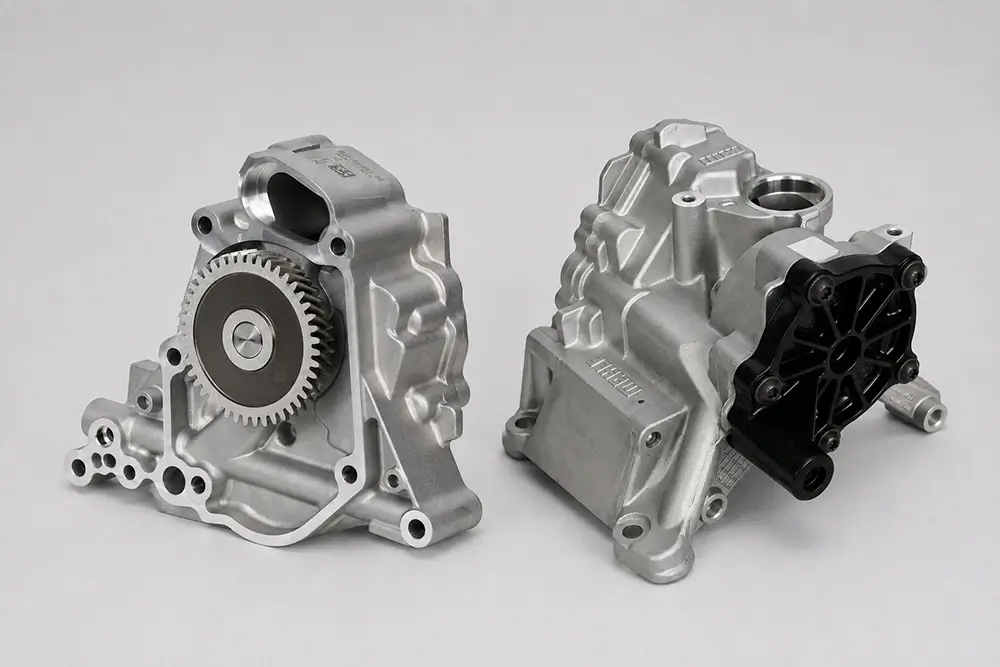
The important point is not that one system is better than the other. They are simply different architectures.
How the N20 Oil Pump Is Driven
BMW’s N20 technical documentation describes a variable-volumetric-flow slide oil pump connected to the counterbalance-shaft housing.
The oil pump itself is located towards the flywheel side of the engine, but the drive originates at the front of the engine.
The simplified mechanical path is:
crankshaft → drive chain → counterbalance-shaft drive → gear reduction → oil pump
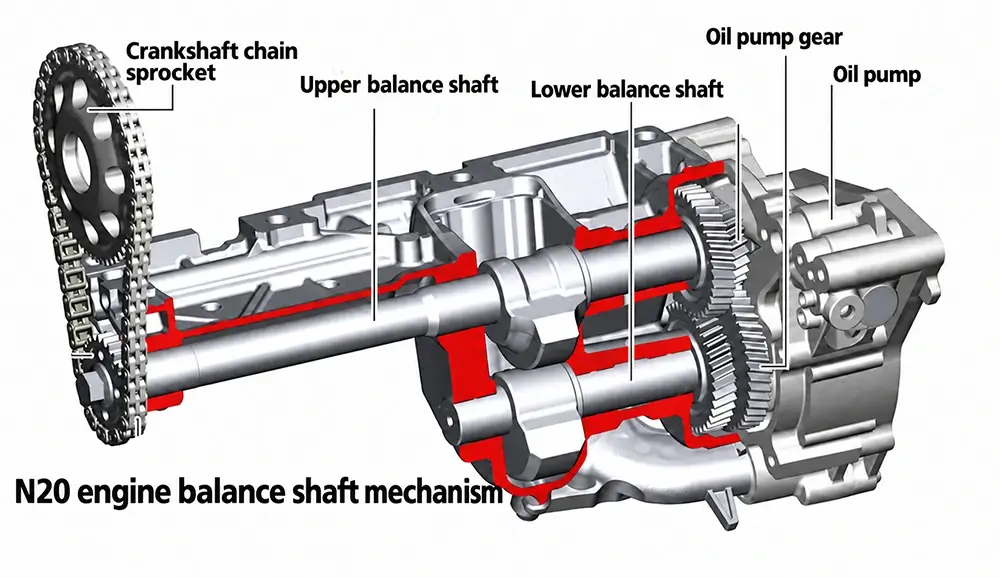
A long drive shaft transmits torque towards the pump and also forms part of the first counterbalance shaft.
This makes the N20 oil pump particularly important to understand as part of a larger mechanical assembly rather than as an isolated pump body.
BMW documentation identifies:
- crankshaft sprocket;
- counterbalance-shaft sprocket;
- drive chain;
- upper and lower counterbalance shafts;
- oil-pump gear;
- oil pump.
For parts buyers, this explains why N20 oil-pump listings often refer to both the oil pump and counterbalance-shaft unit.
Why the N20 Balance Shaft Matters During Oil-Pump Matching
A counterbalance shaft exists to reduce vibration generated by the reciprocating engine.
On the N20, however, its significance for sourcing goes further because the oil-pump drive is mechanically connected to the counterbalance-shaft arrangement.
For procurement, this means the buyer should confirm exactly what is being requested:
oil pump only
or
oil pump with counterbalance-shaft assembly
or
counterbalance-shaft unit
or
drive-chain components
Those descriptions should not be used interchangeably.
N20 OE References Need Their Component Roles Separated
Wellgine currently lists a BMW N20 oil-pump / counterbalance-shaft assembly under references 11277632111 and 11417610378.
The two references describe different component roles within the N20 lower-engine system.
The practical sourcing question is therefore not simply:
“Do you have an N20 oil pump?”
It should be:
“Which component or assembly does the buyer need, and which OE reference is on the original part or catalogue?”
For the current Wellgine N20 product, see the BMW N20 Oil Pump 11277632111 / 11417610378 page.
The exact OE intent should remain with that product page rather than this comparison guide.
The B48 Uses a Different Lower-Engine Architecture
The B48 belongs to BMW’s modular B-series engine family and should not be treated as an updated N20 using the same oil-pump architecture.
BMW technical documentation for later B46TU/B48TU engines describes a separate chain drive from the crankshaft for the combined oil / vacuum-pump system.
The exact layout depends on the B48 generation and technical revision.
This matters because the label B48 oil pump can refer to multiple engine applications and production versions.
Therefore:
B48 family name alone does not prove one universal oil-pump configuration.
B48 Balance Shafts Should Not Be Treated Like the N20 Assembly
One of the most important differences is the relationship between the pump and the engine’s mass-balancing system.
On the N20, the pump drive is directly integrated into the counterbalance-shaft drive arrangement.
On B48 engines, the balance-shaft architecture is organised differently and can vary across technical revisions.
This means a buyer should not apply the N20 assumption:
oil pump + counterbalance shaft = one equivalent B48 sourcing unit
to every B48 application.
The component scope has to be checked from the actual OE reference and engine configuration.
The B48 Oil Pump May Also Be Part of an Oil / Vacuum-Pump Configuration
Another important sourcing difference is terminology.
BMW documentation for later B48-family engines refers to a combined oil / vacuum pump arrangement.
That is different from the way buyers commonly describe the N20 lower oil-pump and counterbalance-shaft assembly.
This terminology matters because a catalogue, supplier or workshop enquiry may say:
- B48 oil pump;
- B48 oil / vacuum pump;
- engine oil pump;
- lubrication pump assembly.
These descriptions should be reconciled with the OE reference before quotation.
A commercial name alone is not enough to confirm the supplied component.
Example B48 Oil-Pump Reference
Wellgine currently lists 11417624135 as an oil-pump reference associated with B46/B48 applications.
The product page already receives Google impressions for both “b48 oil pump” and “bmw b48 oil pump”, so this comparison article should support that product page rather than replace it as the primary exact-product destination.
See the 11417624135 BMW B46/B48 Oil Pump for product-level reference information.
The same engine family can contain additional oil-pump references, so 11417624135 should not be treated as proof that every B48 installation uses the same unit.
N20 vs B48: Why Visual Matching Is Risky
When two pumps are placed side by side, buyers may focus on:
- overall housing shape;
- mounting-hole pattern;
- drive sprocket;
- inlet position;
- outlet position;
- overall size.
These are useful inspection points, but they are not enough by themselves.
A correct replacement also depends on hidden or less obvious relationships such as:
- drive method;
- drive ratio;
- pump-control design;
- oil-passage interfaces;
- balance-shaft relationship;
- vacuum-pump integration where applicable;
- housing depth;
- production revision;
- exact engine variant.
A pump that appears to bolt into place may still belong to a different lubrication architecture.
For that reason:
physical similarity is supporting evidence, not primary fitment proof.
Drive Layout Is a Procurement Characteristic
Drive layout is sometimes treated as workshop information, but it also matters during sourcing.
For the N20, the chain, counterbalance-shaft drive and pump gearing form a recognisable architecture.
For a B48 application, the buyer may instead be dealing with a separate crankshaft-driven oil / vacuum-pump arrangement whose layout depends on the B48 generation.
This affects what should be compared when reviewing samples or supplier photos.
Useful photographs include:
- drive side;
- rear housing;
- mounting face;
- sprocket or drive interface;
- oil inlet;
- pressure outlet;
- balance-shaft interface where relevant;
- vacuum-pump section where applicable.
A single front-view product image is rarely sufficient for reliable OE matching.
Do Not Match by Vehicle Model Alone
The transition from N20 to B48 creates another sourcing trap.
BMW used different engine generations within related vehicle families and production periods.
A model name such as 320i or X1 does not by itself identify the oil pump.
Depending on production year, market and vehicle configuration, a similar model description can be associated with different engine families.
The correct sequence is:
vehicle → production information → engine code → OE reference → pump structure
rather than:
vehicle model → visually similar oil pump
Do Not Match by “2.0 Turbo” Either
Both N20 and B48 are commonly encountered as turbocharged four-cylinder BMW engines.
That does not make “BMW 2.0 turbo oil pump” a reliable procurement specification.
Engine displacement does not tell the buyer:
- N20 or B48 architecture;
- pump drive arrangement;
- balance-shaft configuration;
- OE supersession;
- vehicle production revision.
For a distributor, a vague enquiry such as “BMW 2.0T oil pump” should therefore trigger an application-confirmation step rather than an immediate quotation.
OE Number Should Lead the Matching Process
For professional sourcing, the OE reference remains the strongest starting point.
A practical sequence is:
- identify the engine family;
- record the OE reference from the original part or catalogue;
- confirm vehicle and production information;
- determine whether the requested item is pump-only or an assembly;
- compare the drive-side structure;
- compare mounting and oil-port geometry;
- check superseded references where applicable;
- confirm the final application before ordering.
For a broader explanation of this process, see Wellgine’s How to Source the Correct Engine Oil Pump by OE Number, Engine Code and Application guide.
What Buyers Should Compare Between N20 and B48 Oil Pumps
A useful B2B comparison is not simply N20 versus B48 by appearance. It should compare the complete sourcing context.
| Matching question | N20 | B48 |
|---|---|---|
| Engine family confirmed? | Required | Required |
| OE reference confirmed? | Required | Required |
| Drive layout checked? | Chain / counterbalance-shaft relationship is important | Confirm applicable oil / vacuum-pump drive configuration |
| Balance-shaft relationship checked? | Critical to assembly identification | Confirm separately for the applicable B48 version |
| Pump-only or larger assembly? | Must be specified | Must be specified |
| Vehicle model sufficient? | No | No |
| Engine displacement sufficient? | No | No |
| Production revision relevant? | Yes | Especially important across B48 revisions |
| Sample photos useful? | Yes | Yes |
| Visual similarity sufficient? | No | No |
What Information Should Buyers Send with an Oil-Pump Enquiry?
For N20 or B48 oil-pump enquiries, provide:
- OE number;
- BMW engine code;
- vehicle model;
- production year or date where relevant;
- VIN where required for catalogue verification;
- front-view photograph;
- rear / mounting-face photograph;
- drive-side photograph;
- oil-port photographs;
- pump-only or assembly requirement;
- quantity;
- known superseded references.
For the N20, also clarify whether the enquiry includes the counterbalance-shaft unit.
For the B48, clarify whether the required product is described by the relevant catalogue as an oil pump or combined oil / vacuum-pump assembly.
N20 and B48 Oil Pumps Should Be Treated as Different Sourcing Families
The practical difference between N20 and B48 oil pumps is not simply that one is older and one is newer.
They belong to different engine architectures.
The N20 oil pump is closely tied to a chain-driven counterbalance-shaft arrangement.
The B48 family uses a different modular-engine architecture, with oil-pump and balance-shaft relationships that vary by generation and technical revision.
That means successful sourcing depends on more than a product photograph.
The safest matching sequence is:
engine family → OE reference → drive layout → assembly scope → physical interfaces → vehicle application
For N20 applications, review the BMW N20 Oil Pump 11277632111 / 11417610378.
For B48 applications, review the 11417624135 BMW B46/B48 Oil Pump.
For broader OE matching, use the Engine Oil Pump OE Sourcing Guide.
Technical reference note: N20 drive-layout descriptions in this guide are based on BMW N20 technical-training information. B48 architecture varies across production and technical-update versions; B48 drive and balance-shaft details should therefore be confirmed against the applicable BMW technical documentation and exact engine identification before parts are matched.