The correct glow plug should be identified by cross-checking the OE reference, engine code, vehicle and production details, and verified technical specifications. Vehicle model or visual similarity alone is not a reliable basis for a purchasing decision.
For distributors, importers, wholesalers and engine parts purchasing teams, the objective is not simply to find a glow plug that looks similar. The objective is to create a traceable confirmation record that links the requested part to the intended diesel engine application before a sample or bulk order is approved.
Quick Answer: What Should Be Checked?
- Record the complete OE reference and its source.
- Confirm the engine code, vehicle platform and production period.
- Check the plug voltage separately from the vehicle system voltage.
- Compare the thread, relevant lengths, hex and terminal design.
- Resolve any conflict between catalogues, samples and drawings.
- Obtain application confirmation before final order approval.
Why Glow Plug Identification Requires More Than a Vehicle Model
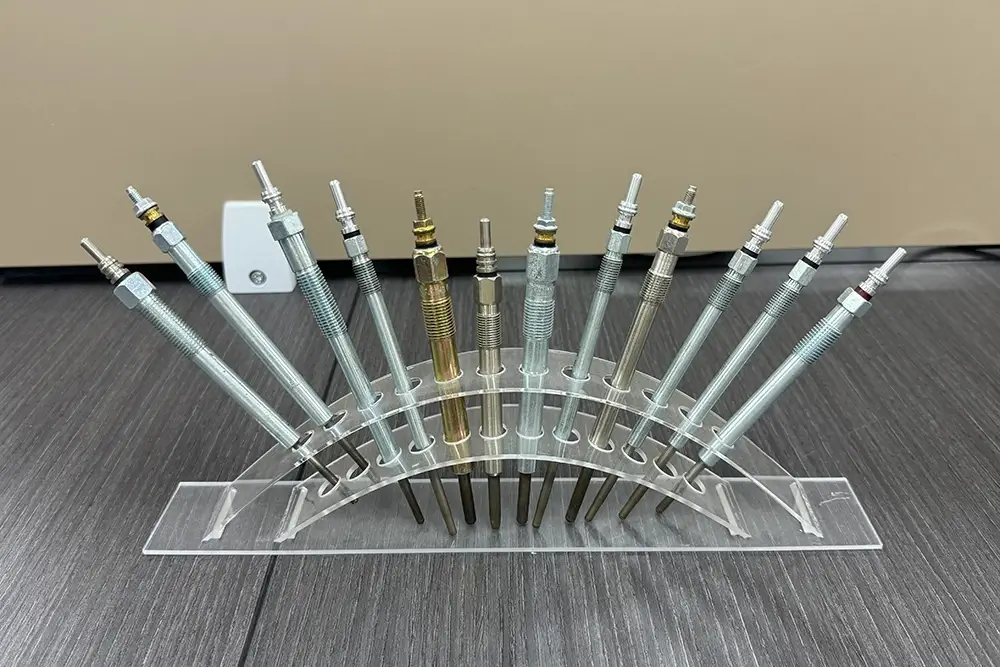
A vehicle name can be useful context, but it does not define the complete application. One model range may include several diesel engines, production changes or market-specific configurations. Even where the engine displacement appears identical, the required glow plug may differ by engine code, production month, electrical system or installation geometry.
Vehicle Names Do Not Define the Complete Application
A request such as “Audi 2.0 TDI glow plug” is not sufficiently precise for a professional order. The description may cover more than one engine family and production period. A buyer should add the engine code, platform, production date and original OE reference wherever these details are available.
Similar Appearance Does Not Confirm Interchangeability
Two glow plugs may have a similar metal body and heating end while differing in rated voltage, thread, reach or terminal design. Matching one visible feature, such as the thread diameter, does not establish complete compatibility. Official application data, a verified supplier catalogue and product drawings should be used together.
Why the Identification Record Matters
For B2B buyers, the cost of an incorrect match is wider than the unit value of the part. A mismatch can create repeated technical checking, sample rejection, catalogue corrections, delayed customer delivery and inventory that cannot be used for the intended application. A documented matching process makes later repeat orders easier to review.
The Evidence Buyers Should Collect Before Product Matching
Good product matching begins with evidence. Each field contributes something different, and no single field should be treated as universal proof when other information conflicts.
OE Reference Number
The OE reference is usually the strongest starting point. Record it exactly, including prefixes, suffixes, spaces and separators. Also record where it came from: the removed part, original packaging, a vehicle parts catalogue, an existing purchase record or a customer-provided cross-reference.
An OE number is a reference for identification. It should not automatically be described as a confirmed application for every market or production period. Related or replacement references also require their scope to be checked.
Engine Code
The engine code helps separate different power units within the same vehicle range. It is often more useful than the vehicle model alone when reviewing an engine component. Where the engine code is available, it should be included in the RFQ and retained in the approval record.
Vehicle and Production Details
Provide the make, model, platform or generation, engine displacement, fuel type, production month and year, and destination market where relevant. Production cut-offs can affect the product decision, particularly when a vehicle family changed its engine or electrical system during its life cycle.
Original Part, Label, Drawing or Sample
A clear photograph, original label, technical drawing or physical sample can provide useful supporting evidence. It can reveal terminal form, thread, hex, markings and dimensional differences. It does not replace application verification: an unmarked sample or photograph cannot prove the correct voltage or the complete engine coverage on its own.
| Evidence | What It Helps Confirm | What It Cannot Confirm Alone |
|---|---|---|
| OE reference | Initial product identity and catalogue search | Fitment in every market and production period |
| Engine code | Engine-family application | The exact product without additional checks |
| Vehicle details | Application context | Engine-specific compatibility by themselves |
| Product photograph | Visible structure, terminal and markings | Rated voltage or complete internal design |
| Measured dimensions | Physical comparison with a drawing | Electrical and application compatibility |
How to Cross-Check an OE Reference
Record the Number Exactly
Do not normalise the reference too early. Keep the original number as supplied and create a second, standardised field for catalogue searching. This reduces the risk of losing a meaningful suffix or confusing two similar references.
Separate Primary, Related and Unverified References
A useful purchasing file distinguishes between a primary OE reference, a verified related reference and an unverified cross-reference. The terms should not be used interchangeably. If a catalogue lists a related number but does not define the vehicle, engine or production scope, treat it as a lead for investigation rather than final approval.
Resolve Conflicting References Before Ordering
Conflicts are common in legacy purchasing records and multi-source catalogues. The number on the customer list may differ from the label on the original sample. An application table may show one reference while a drawing or electrical value points to another product.
When this happens, pause the final match. Keep all source records, submit the conflicting information to the supplier and ask which field was used to confirm the proposed product. The approval should state the matched reference, application scope and any limitation that remains.
| Reference Status | Meaning for the Buyer | Ordering Decision |
|---|---|---|
| Exact verified reference | Strong initial identification evidence | Continue with engine and specification checks |
| Verified related reference | May match within a stated scope | Confirm the engine, production period and market |
| Unverified cross-reference | Useful for investigation only | Do not approve the order on this basis alone |
| Similar-looking number | No reliable identification value | Return to the original source and recheck |
Confirm the Engine and Vehicle Application
Use the Complete Engine Code
The complete engine code should be compared with the application record for the proposed glow plug. Do not shorten the code or substitute the engine displacement. Two engines with the same nominal displacement may use different glow plug systems.
Check the Production Period
Where possible, provide the production month and year rather than a registration year alone. Registration and production dates are not always identical. For applications close to a product-reference change, the production month can be a practical control point.
Include the Target Market When It Is Relevant
Application records may vary by market or catalogue source. A buyer preparing a regional range should state the destination country or target market, particularly when the vehicle specification or reference usage may differ.
When the Engine Code Is Unavailable
Provide the original OE reference, vehicle details, production information, photographs, markings and measured dimensions. A VIN-derived vehicle record supplied by the buyer may also help. The supplier should then state what additional evidence is required before approval.
Compare the Technical Specifications That Affect Compatibility
After the OE and application review, compare the electrical and dimensional profile. The exact fields depend on the product, but the checks below are common in Wellgine’s current glow plug data.
Plug Voltage and Vehicle System Voltage
Keep these as separate fields. In Wellgine product records, P.V. identifies the glow plug’s rated voltage and B.V. identifies the vehicle electrical system voltage. For example, a product record may show a 4.4V plug in a 12V vehicle system. Merging the two values can create a false contradiction or an incorrect catalogue entry.
Mounting Thread and Hex
Check the thread diameter and pitch, then confirm the hex size used as the external tool interface. A matching thread is only one screening point. It does not prove that the heating end, reach, terminal or voltage is correct.
Overall Length and Drawing Reference Dimensions
Compare lengths using the same measurement points shown on the approved drawing. “Overall length”, “installation depth”, “installation length” and “drawing reference dimension” are not automatically interchangeable terms. Record the field name used by the drawing as well as the value.
Terminal Design
Confirm whether the product uses a pin or threaded terminal and compare the relevant dimensions. A terminal mismatch can prevent the intended electrical connection even when the body dimensions appear close.
Additional Product-Specific Fields
Heating-end geometry, construction and control requirements may vary by product family. These fields should be checked against verified product data rather than inferred from a photograph.
| Specification | Buyer Check | Risk If Not Confirmed |
|---|---|---|
| Plug voltage | Compare with verified application data | Electrical mismatch |
| Thread diameter and pitch | Confirm the cylinder-head interface | Installation incompatibility |
| Relevant lengths | Use the same drawing measurement points | Incorrect physical fit |
| Hex size | Record the tool-interface dimension | Incorrect inspection or installation assumptions |
| Terminal design | Compare the connection form and size | Connection mismatch |
A Wellgine Product Comparison: Why One Matching Field Is Not Enough
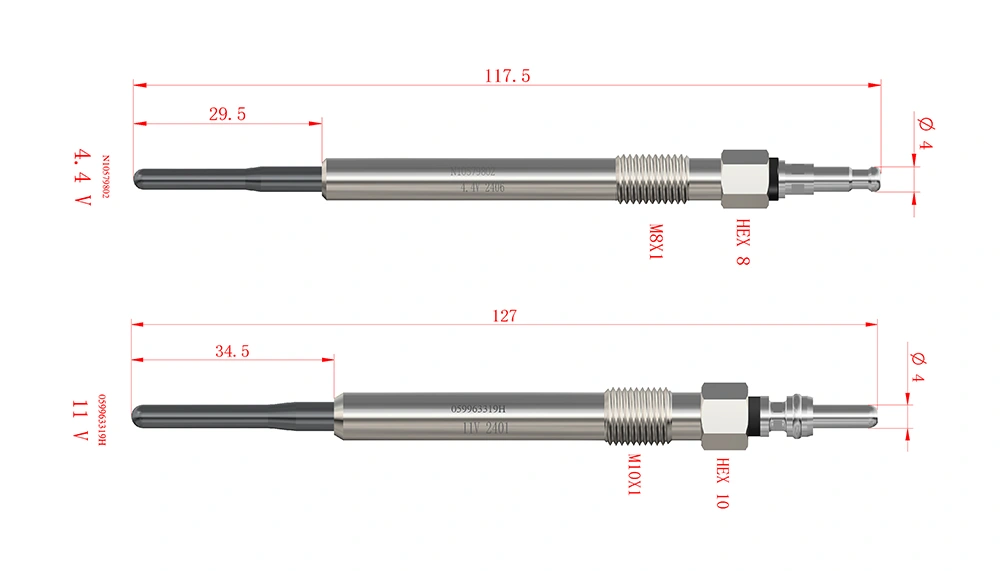
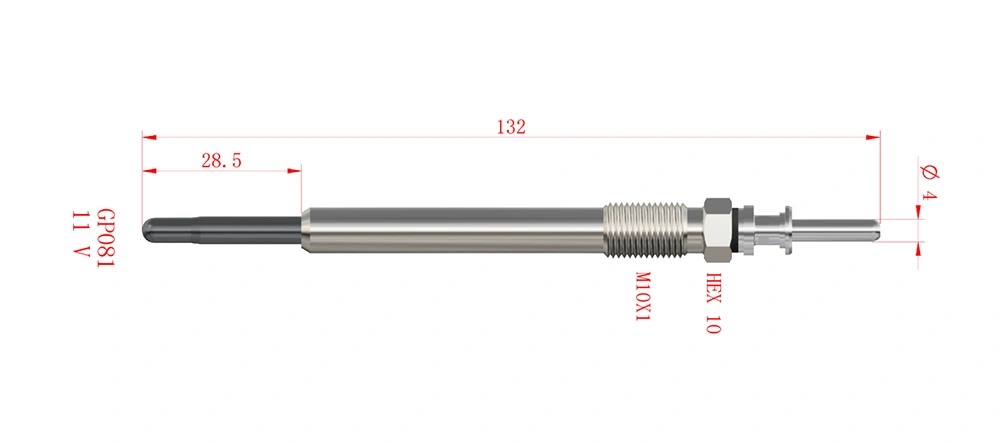
Current Wellgine product data provides a practical illustration. The four examples below are all metal glow plugs within the Audi category, yet their electrical and dimensional identities differ substantially. This is why “Audi glow plug”, the thread alone or visual similarity cannot support a final purchasing decision.
| OE-Reference Product | P.V. | Thread | Overall Length | Reference / Installation Dimension | Terminal |
|---|---|---|---|---|---|
| 059963319H | 11V | M10 × 1 | 127 mm | 34.5 mm drawing reference | Ø4 mm pin |
| N10579802 | 4.4V | M8 × 1 | 117.5 mm | 29.5 mm installation depth | Ø4 mm pin |
| 068 905 061 | 11V | M12 × 1.25 | 65 mm | 20 mm installation length | M5 threaded terminal |
| N10140105 | 11V | M10 × 1 | 92 mm | 24 mm drawing reference | Ø4 mm pin |
These values are product-identification examples from current Wellgine records, not a universal fitment table. The individual product pages retain the responsibility for their OE references, confirmed engine codes, production ranges and application limitations.
A Seven-Step Glow Plug Identification Workflow
1. Capture the Original Request
Keep the buyer’s original OE number, description, vehicle information, photographs and catalogue source. Do not discard conflicting data before it has been reviewed.
2. Normalise the OE Reference
Create a searchable version while preserving the original format. Identify whether the number is primary, related or unverified.
3. Confirm the Engine
Check the complete engine code, vehicle platform and fuel type. If the code is missing, list the evidence that can be used instead.
4. Check Production and Market Details
Confirm the production month and year where available, plus the destination market when it may affect application data.
5. Compare Verified Specifications
Review plug voltage, vehicle system voltage, thread, lengths, hex and terminal against the proposed product record or drawing.
6. Flag Every Conflict
A disagreement in a critical field is a reason to stop and investigate. Do not “average” dimensions, choose the nearest voltage or accept a visually similar product.
7. Obtain and Record Application Confirmation
The approval record should identify the matched product, reference used, engine/application scope, specification basis and any unresolved limitation. Retain it with the quotation and purchase record for future repeat orders.
Common Glow Plug Sourcing Errors
| Common Error | Why It Is Risky | Better Purchasing Practice |
|---|---|---|
| Ordering by model name only | The same model may use several diesel engines or production specifications | Add the engine code and production details |
| Treating a cross-reference as final proof | The source or application scope may be unclear | Verify the reference status and supporting application |
| Approving by thread or appearance | Voltage, reach and terminal may still differ | Compare the complete electrical and dimensional profile |
| Ignoring conflicting records | The proposed product may be based on incomplete evidence | Submit all conflicts for supplier review |
| Using different measurement points | Two correct values may appear inconsistent | Measure according to the same approved drawing |
| Sending quantity without identification data | The supplier cannot confirm the intended product | Send a complete technical and commercial RFQ |
What a Complete Glow Plug RFQ Should Contain
A complete RFQ gives the supplier enough information to identify the product, understand the project and state any limitation before quotation. The minimum information is the OE reference, engine code, vehicle and production details, required quantity and destination market.
Supporting evidence may include photographs of the original part and marking, a drawing, measured dimensions, an existing sample, packaging information and the current cross-reference used in the buyer’s catalogue. For a structured checklist covering other engine parts as well, use Wellgine’s engine parts enquiry guide.
| RFQ Field | Buyer Entry |
|---|---|
| OE reference | |
| Engine code | |
| Vehicle / platform | |
| Production month and year | |
| Required quantity | |
| Destination market | |
| Existing cross-reference | |
| Photo, drawing or sample available | Yes / No |
| Packaging requirement | |
| Unresolved identification question |
How to Evaluate a Supplier’s Confirmation
A useful confirmation should be specific enough for another member of the purchasing team to understand why the product was selected. It should state the matched product and OE reference, the engine or vehicle scope reviewed, the specification fields checked and any remaining condition.
Before approval, ask:
- Which OE reference was used as the primary matching basis?
- Which engine code, platform and production period were reviewed?
- Were the plug and vehicle-system voltages recorded separately?
- Which drawing dimensions and terminal details were compared?
- Does the confirmation contain any market, quantity or installation limitation?
- Is an original sample or further drawing review required?
Keep the response, approved drawing and sample record with the purchase file. This supports repeat-order control and helps prevent an old, incomplete reference from becoming the only basis for a future order.
Wellgine Glow Plug Sourcing Path
Buyers can begin with Wellgine’s glow plug category, then move to a relevant application category such as Audi glow plugs and review the individual OE-reference product page.
Where a match is not immediately clear, send the OE reference, engine code, production details, required quantity and supporting product evidence. Wellgine can review the information for application confirmation and B2B quotation support. Buyers evaluating the wider supply process can also review Wellgine’s quality control information.
Frequently Asked Questions
Can two glow plugs with the same dimensions be interchangeable?
Not on dimensional evidence alone. The plug voltage, terminal, heating-end design, OE reference and engine application must also be checked. Even dimensions should be compared using the same measurement points.
Is an OE number enough to place an order?
It is an important starting point, but the engine code, production period and product specification should still be reviewed. A reference may have a limited application scope or be listed as a related rather than primary number.
What if the original OE number has been replaced?
Ask for the documented relationship and its application scope. Do not assume that every related number covers every engine and production period identically.
Can one vehicle model use more than one glow plug reference?
Yes, a model range may include several engines or production changes. The model name should therefore be combined with the engine code, production date and original reference.
What can a buyer send when the engine code is unknown?
Send the original OE number, vehicle and production details, photographs of the part and marking, measured dimensions and sample availability. The supplier should explain what further evidence is required.
Should the number of glow plugs be assumed from the cylinder count?
Do not use cylinder count as the only ordering rule. Confirm the exact application record and required quantity for the vehicle and engine before finalising the order.
Conclusion
Correct glow plug identification is a cross-checking process, not a one-field lookup. Start with the exact OE reference, confirm the engine and production details, then compare the verified electrical and dimensional profile. Where any critical field conflicts, pause the purchasing decision and obtain a documented application confirmation.
To review a requirement, contact Wellgine with the OE reference, engine code, vehicle and production information, required quantity and any available photographs, drawing or sample details.